
May 2025 Paper 1 Q11
11. The equation \(9x^2+3kx+k=0\) has two real and distinct roots.
Determine the range of values for \(k\).
Justify your answer. [4]
| Mark | Generic scheme | Illustrative scheme |
|---|---|---|
| •1 | use the discriminant | \((3k)^2-4(9)(k)\) |
| •2 | apply condition | \((3k)^2-4(9)(k)>0\) |
| •3 | identify roots of quadratic expression | \(0,\ 4\) |
| •4 | state range with justification | \(k<0\) and \(k>4\) with eg labelled sketch: 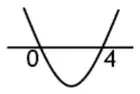 |
| (4) |
Notes:
- At •1, treat the inconsistent use of brackets, for example \(3k^2-4\times 9\times k\), as bad form only if the unbracketed terms are dealt with correctly in the next line of working. See also Candidate F.
- Where candidates do not state an inequality in terms of \(k\) but state expressions for \(a\), \(b\) and \(c\), and \(b^2-4ac>0\), award •2. Where no expressions for \(a\), \(b\) and \(c\) are stated, •2 is only available where •4 is awarded. See Candidates A, B and C.
- If candidates have the condition ‘discriminant \(<0\)’, ‘discriminant \(\leqslant 0\)’ or ‘discriminant \(\geqslant 0\)’, then •2 is lost but •3 and •4 are available.
- Ignore the appearance of \(b^2-4ac=0\) where the correct condition has subsequently been applied. See Candidate D.
- If candidates only work with the condition ‘discriminant = 0’, then •2 and •4 are unavailable. See Candidate E.
- Accept the appearance of 0 and 4 within inequalities for •3.
- For the appearance of \(x\) in any expression of the discriminant, no further marks are available.
Commonly Observed Responses:
Candidate A - no expressions for \(a\), \(b\) and \(c\)
| Two real and distinct roots \(b^2-4ac>0\) | |
| \(9k^2-36k=0\) | •1 ✓ |
| \(k=0,\ k=4\) | •3 ✓ |
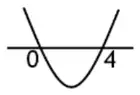 | |
| \(k<0,\ k>4\) | •2 ✓ •4 ✓ |
In this case •2 is only available where •4 is awarded
Candidate B - expressions for \(a\), \(b\) and \(c\)
| \(a=9,\ b=3k,\ c=k\) | |
| \(b^2-4ac>0\) | •2 ✓ |
Candidate C - working with =’0’
| \((3k)^2-4\times 9\times k\) | •1 ✓ |
| \(9k^2-36k=0\) | |
| \(k=0,\ k=4\) | •3 ✓ |
| \(b^2-4ac>0\) | |
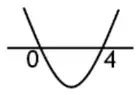 | |
| \(k<0,\ k>4\) | •2 ✓ •4 ✓ |
In this case •2 is only available where •4 is awarded
Candidate D
| \((3k)^2-4\times 9\times k\) | •1 ✓ |
| \(b^2-4ac=0\) | |
| \(9k^2-36k=0\) | |
| \(k=0,\ k=4\) | •3 ✓ |
| \(9k^2-36k>0\) | •2 ✓ |
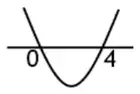 | |
| \(k<0,\ k>4\) | •4 ✓ |
Candidate E - no inequality stated
| \((3k)^2-4\times 9\times k\) | •1 ✓ |
| \(9k^2-36k=0\) | •2 ✗ |
| \(k=0,\ k=4\) | •3 ✓ |
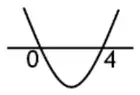 | |
| \(k<0,\ k>4\) | •4 ✗ |
Candidate F - incorrect squaring
| \(3k^2-4\times 9\times k>0\) | •1 ✗ •2 ✓1 |
| \(k=0,\ k=12\) | •3 ✓1 |
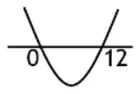 | |
| \(k<0,\ k>12\) | •4 ✓1 |