
May 2024 Paper 2 Q6
6. Two variables, \(x\) and \(y\), are connected by the equation \(y=ax^b\).
The graph of \(\log_5 y\) against \(\log_5 x\) is a straight line as shown.
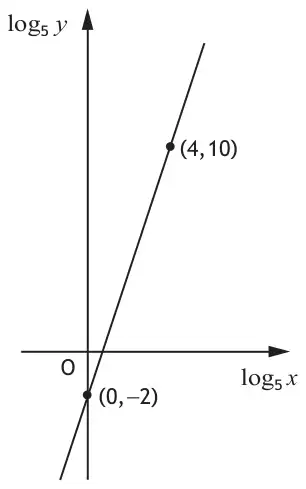
Find the values of \(a\) and \(b\). [5]
| Mark | Generic scheme | Illustrative scheme |
|---|---|---|
| Method 1 | Method 1 | |
| •1 | state linear equation | \(\log_5 y=3\log_5 x-2\) |
| •2 | introduce logs | \(\log_5 y=3\log_5 x-2\log_5 5\) |
| •3 | use laws of logs | \(\log_5 y=\log_5 x^3-\log_5 5^2\) |
| •4 | use laws of logs | \(\log_5 y=\log_5\dfrac{x^3}{5^2}\) |
| •5 | state \(a\) and \(b\) | \(a=\dfrac{1}{25},\ b=3\) or \(y=\dfrac{x^3}{25}\) |
| Method 2 | Method 2 | |
| •1 | state linear equation | \(\log_5 y=3\log_5 x-2\) |
| •2 | use laws of logs | \(\log_5 y=\log_5 x^3-2\) |
| •3 | use laws of logs | \(\log_5\dfrac{y}{x^3}=-2\) |
| •4 | use laws of logs | \(\dfrac{y}{x^3}=5^{-2}\) |
| •5 | state \(a\) and \(b\) | \(a=\dfrac{1}{25},\ b=3\) or \(y=\dfrac{x^3}{25}\) |
| Method 3 | Method 3 The equations at •1, •2 and •3 must be stated explicitly | |
| •1 | introduce logs to \(y=ax^b\) | \(\log_5 y=\log_5 ax^b\) |
| •2 | use laws of logs | \(\log_5 y=b\log_5 x+\log_5 a\) |
| •3 | interpret intercept | \(\log_5 a=-2\) |
| •4 | use laws of logs | \(a=\dfrac{1}{25}\) |
| •5 | interpret gradient | \(b=3\) |
| (5) |
Notes:
- In any method, marks may only be awarded within a valid strategy using \(y=ax^b\). For example, see Candidates C and D.
- Markers must identify the method which best matches the candidate’s approach; markers must not mix and match between methods.
- Penalise the omission of base 5 at most once in any method.
- Where candidates use an incorrect base then only •2 and •3 are available (in any method).
- Do not accept \(a=5^{-2}\).
- In Method 3, do not accept \(m=3\) or gradient \(=3\) for •5.
- Do not penalise candidates who score out “log” from equations of the form \(\log_5 m=\log_5 n\).
Commonly Observed Responses:
Candidate A - missing equations at •1, •2 and •3 in Method 3
| \(a=\dfrac{1}{25}\) | •4 ✓ |
| \(b=3\) | •5 ✓ |
Candidate B - no working - Method 3
| \(b=\dfrac{1}{25}\) | •4 ✗ |
| \(a=3\) | •5 ✗ |
Candidate C - Method 2
| \(y=3x-2\) | |
| \(\log_5 y=3\log_5 x-2\) | •1 ✓ |
| \(\log_5 y=\log_5 x^3-2\) | •2 ✓ |
| \(y=x^3-2\) | •3 ✗ •4 ✗ •5 ✗ |
[Annotation in the marking instructions: \(y=3x-2\) is wavy-underlined]
Candidate D - Method 2
| \(\log_5 y=3\log_5 x-2\) | •1 ✓ |
| \(\log_5 y=\log_5 x^3-2\) | •2 ✓ |
| \(\dfrac{y}{x^3}=-2\) | •3 ✗ •4 ✗ •5 ✗ |
Candidate E - use of coordinate pairs
| \(\log_5 x=4\) and \(\log_5 y=10\) | •1 ✓ |
| \(x=5^4\) and \(y=5^{10}\) | •2 ✓ |
| \(\log_5 x=0,\ \log_5 y=-2\) | |
| \(\Rightarrow x=1,\ y=5^{-2}\) | •3 ✓ |
| \(5^{-2}=a\times 1^b\Rightarrow a=\dfrac{1}{25}\) | •4 ✓ |
| \(5^{10}=5^{-2}\times 5^{4b}\Rightarrow -2+4b=10\) | |
| \(\Rightarrow b=3\) | •5 ✓ |
Candidates may use \((0,-2)\) for •1 and •2 and \((4,10)\) for •3.