
May 2023 Paper 2 Q15
15. The line \(x+3y=17\) is a tangent to a circle at the point (2, 5).
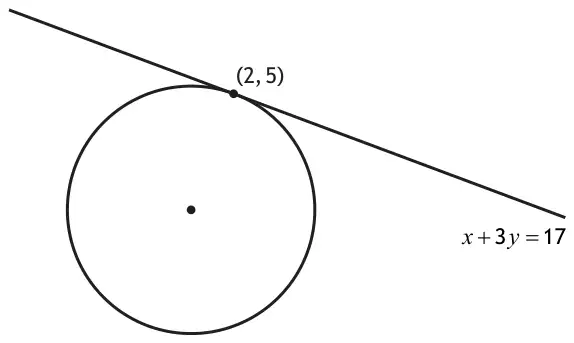
The centre of the circle lies on the \(y\)-axis.
Find the coordinates of the centre of the circle. [4]
| Mark | Generic scheme | Illustrative scheme |
|---|---|---|
| •1 | determine gradient of tangent | \(-\dfrac{1}{3}\) |
| •2 | determine gradient of radius | \(3\) |
| •3 | strategy to find centre | eg \(y=3x-1\) or \(3=\dfrac{y-5}{x-2}\) |
| •4 | state coordinates of centre | \((0,-1)\) |
| (4) |
Notes:
- Ignore errors in processing the constant term in •1.
- Do not accept \(m=-\dfrac{1}{3}x\) for •1. However •2, •3 and •4 are still available where the candidate uses a numerical value for \(m_{\perp}\).
- Accept \(y-5=3(x-2)\) as evidence for •3.
- •4 is only available as a consequence of trying to find and use a perpendicular gradient along with a point on the \(y\)-axis.
- Where candidates use “stepping out” with the perpendicular gradient, the diagram must be consistent with the solution to gain •3 and •4.
- Accept “\(x=0\)”, “\(y=-1\)” stated explicitly for •4.
Commonly Observed Responses:
Candidate A - perpendicular gradient clearly stated
| \(x+3y=17\) | |
| \(m_{\perp}=3\) | •1 ✓ •2 ✓ |
| \(y=3x-1\) | •3 ✓ |
Candidate B - no communication for perpendicular gradient
| \(x+3y=17\) | |
| \(y=-\dfrac{1}{3}x+\dfrac{17}{3}\) | |
| \(m=3\) | •1 ^ •2 ✓1 |
| \(y=3x-1\) | •3 ✓1 |
| •4 is available |
Candidate C - no communication for perpendicular gradient or rearrangement
| \(x+3y=17\) | |
| \(m=3\) | •1 ^ •2 ^ |
| \(y=3x-1\) | •3 ✓2 |
| •4 is not available |
Candidate D - using geometry
| \(\vdots\) | •1 ✓ •2 ✓ •3 ✓ |
| Using point diametrically opposite (2,5), by symmetry identify that \(x\)-coordinate is \(-2\). | |
| \(\therefore y=3(-2)-1=-7\). | |
| Centre is midpoint of (−2,−7) and (2,5). \(\therefore\) centre is (0,−1) | •4 ✓ |
Candidate E - incorrect gradient
| \(x+3y=17\) | |
| \(3y=-x+17\) | |
| \(m_{\perp}=1\) | •1 ^ •2 ✗ |
| \(1=\dfrac{5-y}{2-0}\) | •3 ✓1 |
| Centre is at \((0,3)\) | •4 ✓1 |