
May 2023 Paper 2 Q14
14. A net of an open box is shown.
The box is a cuboid with height \(h\) centimetres.
The base is a rectangle measuring \(3x\) centimetres by \(2x\) centimetres.
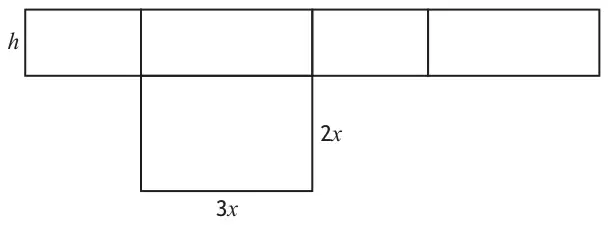
(a)
(i) Express the area of the net, \(A\) cm2, in terms of \(h\) and \(x\). [1]
(ii) Given that \(A=7200\) cm2, show that the volume of the box, \(V\) cm3, is given by \(V=4320x-\dfrac{18}{5}x^3\). [2]
(b) Determine the value of \(x\) that maximises the volume of the box. [4]
| Mark | Generic scheme | Illustrative scheme |
|---|---|---|
| •1 | express \(A\) in terms of \(x\) and \(h\) | \((A=)\,6x^2+10xh\) |
| (1) |
Notes:
- Accept unsimplified expressions for •1.
| Mark | Generic scheme | Illustrative scheme |
|---|---|---|
| •2 | express \(h\) in terms of \(x\) | \(h=\dfrac{7200-6x^2}{10x}\) |
| •3 | substitute for \(h\) and demonstrate result | \(V=3x\times2x\times\left(\dfrac{7200-6x^2}{10x}\right)\) leading to \(V=4320x-\dfrac{18}{5}x^3\) |
| (2) |
Notes:
- •2 is only available where the (simplified) expression for \(A\) contains at least 2 terms.
- The substitution for \(h\) at •3 must be clearly shown for •3 to be awarded.
| Mark | Generic scheme | Illustrative scheme | ||||||||||||
|---|---|---|---|---|---|---|---|---|---|---|---|---|---|---|
| •4 | differentiate | \(4320-\dfrac{54}{5}x^2\) | ||||||||||||
| •5 | equate expression for derivative to 0 | \(4320-\dfrac{54}{5}x^2=0\) | ||||||||||||
| •6 | solve for \(x\) | \(20\) | ||||||||||||
| •7 | verify nature | table of signs for a derivative
| ||||||||||||
| (4) |
Notes:
- For any approach which does not use differentiation award 0/4.
- •5 can be awarded for \(\dfrac{54}{5}x^2=4320\).
- For candidates who integrate any term at the •4 stage, only •5 is available on follow through for setting their ‘derivative’ to 0.
- Ignore the appearance of \(-20\) at mark •6.
- Where \(-20\) is considered in a nature table (or second derivative), “\(x=20\)” must be clearly identified as leading to the maximum volume.
- •6 and •7 are not available to candidates who state that the maximum exists at a negative value of \(x\).
- Do not penalise statements such as “max volume is 20” or “max is 20” at •7.
Commonly Observed Responses:
Candidate A - second derivative
| \(V''(x)=-\dfrac{108}{5}x\) | |
| \(V''(20)<0\ \therefore\) maximum | •7 ✓ |
Candidate B - beware of multiplying before equating
| \(V'(x)=4320-\dfrac{54}{5}x^2\) | •4 ✓ |
| \(V'(x)=21600-54x^2\) | |
| \(21600-54x^2=0\) | •5 ✗ |
| \(x=20\) | •6 ✓1 |
Candidate C
| Stationary points when \(V'(x)=0\) | |
| \(V'(x)=4320-\dfrac{54}{5}x^2\) | •4 ✓ •5 ✓ |
For the table of signs for a derivative, accept:
| \(x\) | \(20^-\) | \(20\) | \(20^+\) |
| \(V'(x)\) | \(+\) | \(0\) | \(-\) |
| Slope or shape | \(\diagup\) | — | \(\diagdown\) |
| \(x\) | \(\rightarrow\) | \(20\) | \(\rightarrow\) |
| \(V'(x)\) | \(+\) | \(0\) | \(-\) |
| Slope or shape | \(\diagup\) | — | \(\diagdown\) |
Arrows are taken to mean ‘in the neighbourhood of’
| \(x\) | \(a\) | \(20\) | \(b\) |
| \(V'(x)\) | \(+\) | \(0\) | \(-\) |
| Slope or shape | \(\diagup\) | — | \(\diagdown\) |
Where \(a<20\) and \(b>20\)
For the table of signs for a derivative, accept:
| \(x\) | \(\rightarrow\) | \(-20\) | \(\rightarrow\) | \(20\) | \(\rightarrow\) |
| \(V'(x)\) | \(-\) | \(0\) | \(+\) | \(0\) | \(-\) |
| Slope or shape | \(\diagdown\) | — | \(\diagup\) | — | \(\diagdown\) |
Since the function is continuous \(-20\rightarrow20\) is acceptable
| \(x\) | \(a\) | \(-20\) | \(b\) | \(20\) | \(c\) |
| \(V'(x)\) | \(-\) | \(0\) | \(+\) | \(0\) | \(-\) |
| Slope or shape | \(\diagdown\) | — | \(\diagup\) | — | \(\diagdown\) |
Since the function is continuous \(-20<b<20\) is acceptable
- For this question do not penalise the omission of ‘\(x\)’ or the word ‘shape’/‘slope’.
- Stating values of \(V'(x)\) is an acceptable alternative to writing ‘\(+\)’ or ‘\(-\)’ signs.
- Acceptable variations of \(V'(x)\) are: \(V'\), \(\dfrac{dV}{dx}\), and \(4320-\dfrac{54}{5}x^2\). Accept \(\dfrac{dy}{dx}\) only where candidates have previously used \(y=4320x-\dfrac{18}{5}x^3\) in their working.
Corrected by Westie's Workshop
- The board's marking instructions printed “leading to the maximum area”. Changed to “leading to the maximum volume” because the question asks for the value of \(x\) that gives the maximum volume of the box; the area is fixed at 7200 cm².
Original: see the board's marking instructions PDF (link above).