
May 2023 Paper 1 Q8
8. A function, \(f\), is defined on \(\mathbb{R}\), the set of real numbers, by \(f(x)=x^3+3x^2-9x+5\).
Find the coordinates of the stationary points of \(f\) and determine their nature. [6]
| Mark | Generic scheme | Illustrative scheme |
|---|---|---|
| •1 | start to differentiate | \(3x^2\ldots\) or \(\ldots+6x\ldots\) or \(\ldots-9\) |
| •2 | complete differentiation and equate to 0 | \(3x^2+6x-9=0\) |
| •3 | solve for \(x\) | \(-3\) and \(1\) |
| •4 | process for \(y\) | \(32\) and \(0\) |
| •5 | construct nature table(s) | 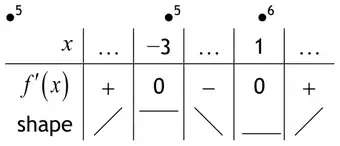 |
| •6 | interpret and state conclusions | max at \((-3,32)\); min at \((1,0)\) |
| (6) |
(In the marking instructions, horizontal-marking labels •3 and •4 are printed above “\(-3\) and \(1\)”.)
Notes:
- For a numerical approach award 0/6.
- •2 is only available if ‘\(=0\)’ appears at the •2 stage or in working leading to •3, however see Candidates A and B.
- Candidates who equate their derivative to 0, may use division by 3 as a strategy - see candidates B, C and D.
- •3 is available to candidates who factorise their derivative from •2 as long as it is of equivalent difficulty.
- •3 and •4 may be awarded vertically.
- •5 is not available where any errors are made in calculating values of \(f^{\prime}(x)\).
- •5 and •6 may be awarded vertically.
- •6 is still available in cases where a candidates table of signs does not lead legitimately to a maximum/minimum shape.
- Candidates may use the second derivative - see Candidates E and F.
- Accept “max when \(x=-3\)” and “min when \(x=1\)” for •6.
Commonly Observed Responses:
Candidate A
| Stationary points when \(f^{\prime}(x)=0\) | |
| \(f^{\prime}(x)=3x^2+6x-9\) | •1 ✓ •2 ✓ |
| \(f^{\prime}(x)=3(x+3)(x-1)\) | |
| \(x=-3,\ 1\) | •3 ✓ |
Candidate B
| Stationary points when \(f^{\prime}(x)=0\) | |
| \(f^{\prime}(x)=3x^2+6x-9\) | •1 ✓ •2 ✓ |
| \(\vdots\) | |
| \(f^{\prime}(x)=(x+3)(x-1)\) | |
| \(x=-3,\ 1\) | •3 ✓ |
(In the marking instructions the \(f^{\prime}(x)\) in \(f^{\prime}(x)=(x+3)(x-1)\) is underlined with a red wavy line.)
Candidate C - division by 3
| \(3x^2+6x-9=0\) | •1 ✓ •2 ✓ |
| \(x^2+2x-3=0\) | |
| \(x=-3,\ 1\) | •3 ✓ |
Candidate D - derivative never equated to 0
| \(3x^2+6x-9\) | •1 ✓ •2 ^ |
| \(x^2+2x-3=0\) | |
| \(x=-3,\ 1\) | •3 ✓1 |
Candidate E - second derivative
| \(f^{\prime\prime}(x)=6x+6\) | •5 ✓ •6 ✓ |
| \(f^{\prime\prime}(-3)<0\) \(f^{\prime\prime}(1)>0\) | •5 ✓ |
| so max at \((-3,32)\) so min at \((1,0)\) | •6 ✓ |
(Horizontal marking: the first •5 ✓ and •6 ✓ are printed above the \(x=-3\) and \(x=1\) columns respectively; the second •5 ✓ and •6 ✓ are at the end of the rows.)
Candidate F - second derivative
| \(f^{\prime\prime}(x)=6x+6\) | •5 ✓ •6 ✓ |
| \(f^{\prime\prime}(-3)=-12\), \(f^{\prime\prime}(1)=12\) | •5 ✓ |
| \(-12<0\) \(12>0\) | |
| so max at \((-3,32)\) so min at \((1,0)\) | •6 ✓ |
(Horizontal marking: the first •5 ✓ and •6 ✓ are printed above the \(x=-3\) and \(x=1\) columns respectively; the second •5 ✓ and •6 ✓ are at the end of the rows.)
For the table of signs for a derivative, accept:
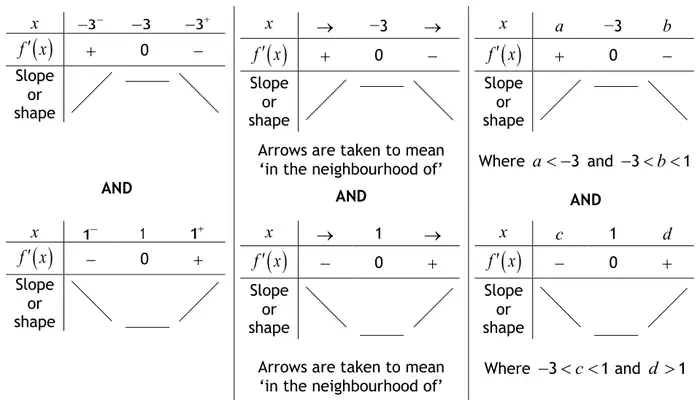
For the table of signs for a derivative, accept:
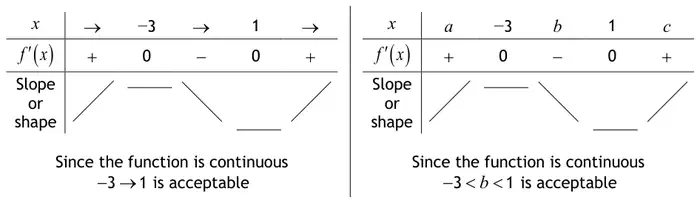
- For this question do not penalise the omission of ‘\(x\)’ or the word ‘shape’/‘slope’.
- Stating values of \(f^{\prime}(x)\) is an acceptable alternative to writing ‘\(+\)’ or ‘\(-\)’ signs.
- Acceptable variations of \(f^{\prime}(x)\) are: \(f^{\prime}\), \(\dfrac{df}{dx}\), \(\dfrac{dy}{dx}\), \(3x^2+6x-9\) and \(3(x+3)(x-1)\) but NOT \(x^2+2x-3\) or \((x+3)(x-1)\).