
May 2022 Paper 2 Q9
9. The line \(y=3x+7\) intersects the circle \(x^2+y^2-4x-6y-7=0\) at the points P and Q.
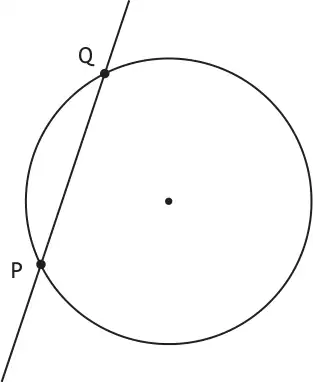
(a) Find the coordinates of P and Q. [5]
PQ is a tangent to a second, smaller circle.
This circle is concentric with the first.
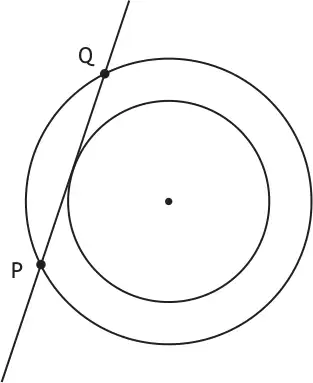
(b) Determine the equation of the smaller circle. [4]
| Mark | Generic scheme | Illustrative scheme |
|---|---|---|
| •1 | substitute for \(y\) in equation of circle | \(x^2+(3x+7)^2-4x-6(3x+7)-7=0\) |
| •2 | arrange in standard quadratic form | \(10x^2+20x=0\) |
| •3 | factorise | \(10x(x+2)=0\) |
| •4 | state \(x\) coordinates | \(0\qquad -2\) |
| •5 | state corresponding \(y\) coordinates | \(7\qquad 1\) |
| (5) |
In the illustrative scheme the two columns of answers are headed •4 (\(x=0\), \(y=7\)) and •5 (\(x=-2\), \(y=1\)), to show horizontal marking.
Notes:
- •1 is only available if ‘\(=0\)’ appears by the •3 stage.
- At •3, the quadratic must lead to two distinct real roots for •4 and •5 to be available.
- At •3 do not penalise candidates who fail to extract the common factor or who have divided the quadratic equation by 10.
- If a candidate arrives at an equation which is not a quadratic at •2 stage, then •3, •4 and •5 are not available
- •3 is available for substituting correctly into the quadratic formula.
- •4 and •5 may be marked either horizontally or vertically.
- Ignore incorrect labelling of P and Q.
Commonly Observed Responses:
Candidate A - substituting for \(y\)
| \(\left(\dfrac{y-7}{3}\right)^2+y^2-4\left(\dfrac{y-7}{3}\right)-6y-7=0\) | •1 ✓ |
| \(\dfrac{10y^2-80y+70}{9}=0\) | •2 ✓ |
| \(10(y-1)(y-7)=0\) | •3 ✓ |
| \(y=1\) or \(y=7\) | •4 ✓ |
| \(x=-2\) or \(x=0\) | •5 ✓ |
| Mark | Generic scheme | Illustrative scheme |
|---|---|---|
| •6 | state centre of circle | \((2,\ 3)\) |
| •7 | calculate midpoint of PQ | \((-1,\ 4)\) |
| •8 | calculate radius of small circle | \(\sqrt{10}\) |
| •9 | state equation of small circle | \((x-2)^2+(y-3)^2=10\) |
| (4) |
Notes:
- Evidence for •6 may appear in part (a).
- Where a candidate uses coordinates for P and Q without supporting working, •7 is not available, however •8 and •9 may be awarded.
- Where candidates find the equation of the larger circle •8 and •9 are not available.
Commonly Observed Responses:
Candidate B - using substitution
| Equation of smaller circle of form | |
| \((x-2)^2+(y-3)^2=r^2\) | •6 ✓ |
| Midpoint PQ \((-1,\ 4)\) | •7 ✓ |
| \((-1-2)^2+(4-3)^2=r^2\) | |
| \(r^2=10\) | •8 ✓ |
| \((x-2)^2+(y-3)^2=10\) | •9 ✓ |
Candidate C - using tangency
| Equation of smaller circle of form | |
| \((x-2)^2+(y-3)^2=r^2\) | •6 ✓ |
| Since \(y=3x+7\) is tangent to smaller circle | |
| \(10x^2+20x+20-r^2=0\) has equal roots | |
| \(\Rightarrow 20^2-4(10)\left(20-r^2\right)=0\) | •7 ✓ |
| \(\Rightarrow r^2=10\) | •8 ✓ |
| \((x-2)^2+(y-3)^2=10\) | •9 ✓ |
Candidate D - using P or Q to mid-point as radius
| \(\vdots\) | |
| \(r=\sqrt{(-2+1)^2+(1-4)^2}=\sqrt{10}\) | •8 ✗ |
| or | |
| \(r=\sqrt{(0+1)^2+(7-4)^2}=\sqrt{10}\) | •8 ✗ |
| \((x-2)^2+(y-3)^2=10\) | •9 ✓2 |