
May 2022 Paper 2 Q8
8. A rectangular plot consists of a rectangular pond surrounded by a path.
The length and breadth of the plot are \(x\) metres and \(y\) metres respectively.
The path is 1.5 metres wide at the ends of the pond and 1 metre wide along the other sides as shown.
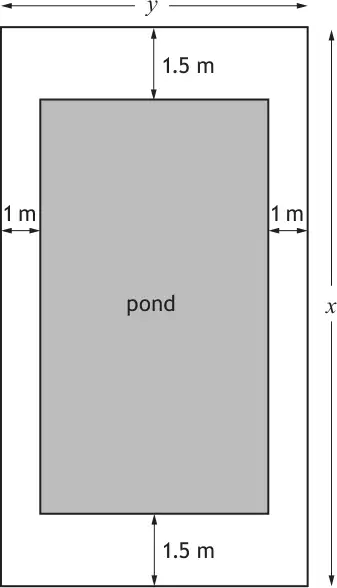
The total area of the pond and path together is 150 square metres.
(a) Show that the area of the pond, \(A\) square metres, is given by \[A(x)=156-2x-\frac{450}{x}.\] [3]
(b) Determine the maximum area of the pond. [6]
| Mark | Generic scheme | Illustrative scheme |
|---|---|---|
| •1 | determine expression for area of pond | \((x-3)(y-2)\) stated or implied by •3 |
| •2 | obtain expression for \(y\) | \(y=\dfrac{150}{x}\) |
| •3 | demonstrate result | \(A(x)=(x-3)\left(\dfrac{150}{x}-2\right)\) eg \(A(x)=\dfrac{150x}{x}-\dfrac{450}{x}-2x+6\) \(A(x)=156-2x-\dfrac{450}{x}\) |
| (3) |
Notes:
- Accept any legitimate variations for the area of the pond in •1, eg \(A=150-2(x-3)-2(y)(1.5)\).
- Do not penalise the omission of brackets at •1. See Candidate A.
- The substitution for \(y\) at •3 must be clearly shown for •3 to be available.
Commonly Observed Responses:
Candidate A
| \(A(x)=x-3\times y-2\) | •1 ✓ |
| \(A(x)=x-3\times\dfrac{150}{x}-2\) | •2 ✓ |
| \(A(x)=156-2x-\dfrac{450}{x}\) | •3 ^ |
| Mark | Generic scheme | Illustrative scheme |
|---|---|---|
| •4 | express \(A\) in differentiable form | \(156-2x-450x^{-1}\) stated or implied by •5 |
| •5 | differentiate | \(-2+450x^{-2}\) |
| •6 | equate expression for derivative to 0 | \(-2+450x^{-2}=0\) |
| •7 | solve for \(x\) | \(x=15\) |
| •8 | verify nature of stationary point | table of signs for derivative \(\therefore\) maximum or \(A^{\prime\prime}(x)=-900x^{-3}\) and \(A^{\prime\prime}(15)\lt 0\) \(\therefore\) maximum |
| •9 | determine maximum area | \(A=96\left(\text{m}^2\right)\) |
| (6) |
Notes:
- For a numerical approach award 0/6.
- •6 can be awarded for \(450x^{-2}=2\).
- For candidates who integrate any term at the •5 stage, only •6 is available on follow through for setting their ‘derivative’ to 0.
- •7, •8, and •9 are only available for working with a derivative which contains an index \(\leqslant -2\).
- \(\sqrt{\dfrac{450}{2}}\) must be simplified at •7 or •8 for •7 to be awarded.
- Ignore the appearance of \(-15\) at mark •7.
- •8 is not available to candidates who consider a value of \(x\leqslant 0\) in the neighbourhood of 15.
- •9 is still available in cases where a candidate’s table of signs does not lead legitimately to a maximum at •8.
- •8 and •9 are not available to candidates who state that the maximum exists at a negative value of \(x\).
Notes (continued)
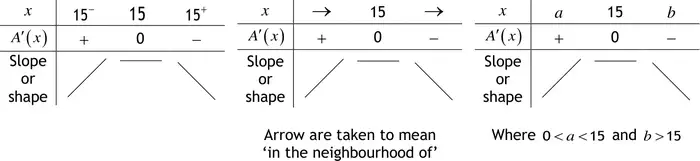
For the table of signs for a derivative, accept:
For the table of signs for a derivative, do not accept:
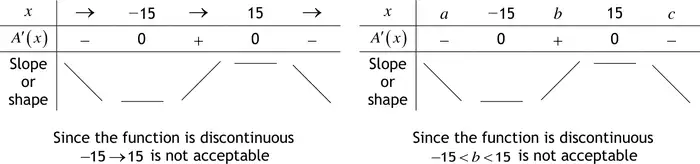
- For this question do not penalise the omission of ‘\(x\)’ or the word ‘shape’/‘slope’.
- Stating values of \(A^{\prime}(x)\) is an acceptable alternative to writing ‘\(+\)’ or ‘\(-\)’ signs.
- Acceptable variations of \(A^{\prime}(x)\) are: \(A^{\prime}\), \(a^{\prime}(x)\), \(\dfrac{dA}{dx}\), and \(-2+450x^{-2}\).
Commonly Observed Responses:
Candidate B - differentiating over multiple lines
| •4 ^ | |
| \(A^{\prime}(x)=-2-450x^{-1}\) | |
| \(A^{\prime}(x)=-2+450x^{-2}\) | •5 ✗ |
| \(-2+450x^{-2}=0\) | •6 ✓1 |
Candidate C - differentiating over multiple lines
| \(A(x)=156-2x-450x^{-1}\) | •4 ✓ |
| \(A^{\prime}(x)=-2-450x^{-1}\) | |
| \(A^{\prime}(x)=-2+450x^{-2}\) | •5 ✗ |
| \(-2+450x^{-2}=0\) | •6 ✓1 |