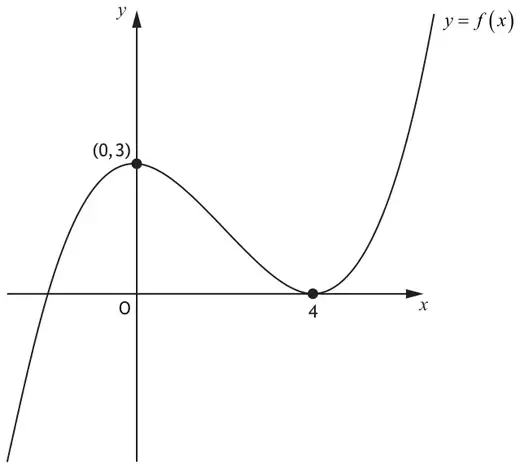
10. The diagram shows the graph of a cubic function with equation \(y=f(x)\).
The curve has stationary points at \((0,3)\) and \((4,0)\).
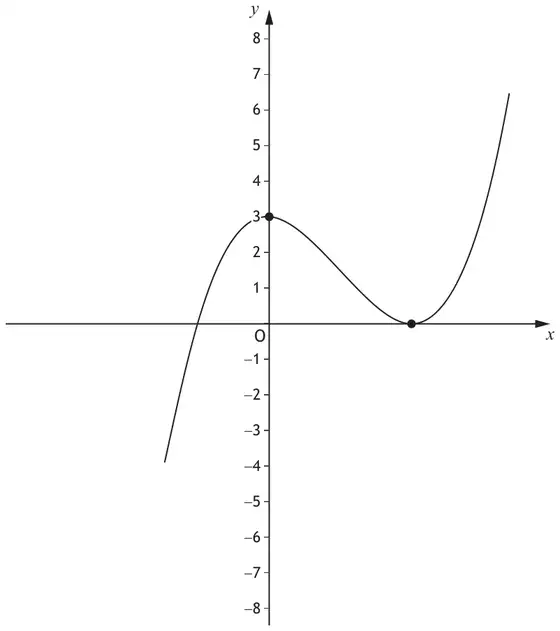
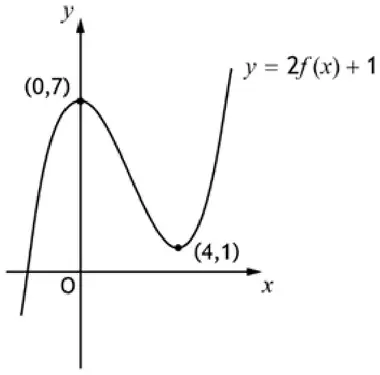
(a) Sketch the graph of \(y=2f(x)+1\). Use the diagram provided below. [3]
(b) State the coordinates of the stationary points on the graph of \(y=f\left(\dfrac{1}{2}x\right)\). [1]
Marking instructions (a)
Mark
Generic scheme
Illustrative scheme
•1
vertical scaling by a factor of 2 identifiable from graph
•1 •2 •3
•2
vertical translation of ‘\(+1\)’ units identifiable from graph
•3
transformations applied in correct order
(3)
Notes:
•1, •2 and •3 are only available for a ‘cubic’ with a maximum and minimum turning point.
Ignore intersections (or lack of intersections) with the original graph.
Commonly Observed Responses:
Where the image of (4,0) is not (4,1), that point must be annotated (or drawn to within tolerance). In the following table, the images of the given points must be stationary points for the marks to be awarded.
Image of (0,3)
Image of (4,0)
Award…
(0,8)
(4,2)
2/3
Transformation in wrong order
(0,4) (0,4) (0,4)
(8,1) (4,1) (2,1)
1/3 1/3 1/3
Only vertical translation correct
(0,5)
(4,−1)
2/3
Evidence of vertical scaling and transformation in correct order
We'd like to use Google Analytics cookies to count visits and see which pages help most. They're optional, and the site works exactly the same either way. Privacy policy