
May 2022 Paper 1 Q7
7. Triangles ABC and ADE are both right angled.
Angle \(\text{BAC}=q\) and angle \(\text{DAE}=r\) as shown in the diagram.
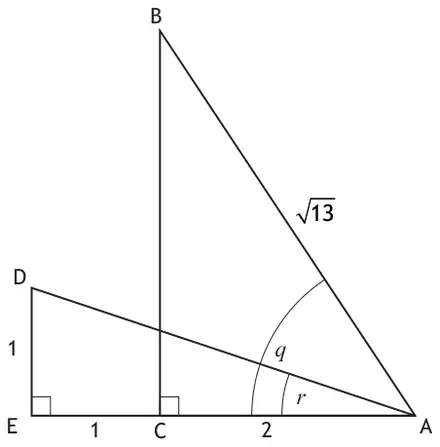
(a) Determine the value of:
(i) \(\sin r\) [1]
(ii) \(\sin q\). [1]
(b) Hence determine the value of \(\sin(q-r)\). [3]
| Mark | Generic scheme | Illustrative scheme |
|---|---|---|
| •1 | determine \(\sin r\) | \(\dfrac{1}{\sqrt{10}}\) |
| (1) |
| Mark | Generic scheme | Illustrative scheme |
|---|---|---|
| •2 | determine \(\sin q\) | \(\dfrac{3}{\sqrt{13}}\) |
| (1) |
Notes:
- In (a)(ii), where candidates do not simplify the perfect square see Candidates A and B.
Commonly Observed Responses:
Candidate A
| \(\sin q=\dfrac{\sqrt{9}}{\sqrt{13}}\) | •2 ✓2 |
Candidate B - simplification in part (b)
| (a)(ii) \(\sin q=\dfrac{\sqrt{9}}{\sqrt{13}}\) | •2 ✓ |
| (b) \(\sin(q-r)=\dfrac{7}{\ldots}\) |
(Callout in the marking instructions, pointing to the 7: “Roots have been simplified in (b)”.)
| Mark | Generic scheme | Illustrative scheme |
|---|---|---|
| •3 | select appropriate formula and express in terms of \(q\) and \(r\) | \(\sin q\cos r-\cos q\sin r\) stated or implied by •4 |
| •4 | substitute into addition formula | \(\dfrac{3}{\sqrt{13}}\times\dfrac{3}{\sqrt{10}}-\dfrac{2}{\sqrt{13}}\times\dfrac{1}{\sqrt{10}}\) |
| •5 | evaluate \(\sin(q-r)\) | \(\dfrac{7}{\sqrt{130}}\) |
| (3) |
Notes:
- Award •3 for candidates who write \(\sin\left(\dfrac{3}{\sqrt{13}}\right)\times\cos\left(\dfrac{3}{\sqrt{10}}\right)-\sin\left(\dfrac{2}{\sqrt{13}}\right)\times\cos\left(\dfrac{1}{\sqrt{10}}\right)\). •4 and •5 are unavailable.
- For any attempt to use \(\sin(q-r)=\sin q-\sin r\), •4 and •5 are unavailable.
- At •5, the answer must be given as a single fraction. Accept \(\dfrac{7}{\sqrt{13}\sqrt{10}}\), \(\dfrac{7\sqrt{10}}{10\sqrt{13}}\) and \(\dfrac{7\sqrt{13}}{13\sqrt{10}}\).
- Do not penalise trigonometric ratios which are less than \(-1\) or greater than 1.
Corrected by Westie's Workshop
- The board's marking instructions printed “express in terms of \(p\) and \(q\)”. Changed to “express in terms of \(q\) and \(r\)” because the angles in this question are \(q\) and \(r\); there is no angle \(p\).
Original: see the board's marking instructions PDF (link above).