
May 2025 Paper 2 Q11
11.
(a) Using the substitution \(u=2x^2\), or otherwise, find \(\displaystyle\int xe^{-2x^2}\,dx\). [2]
The diagram shows part of the curve with equation \(y=\dfrac{4\sqrt{x}}{e^{x^2}}\).
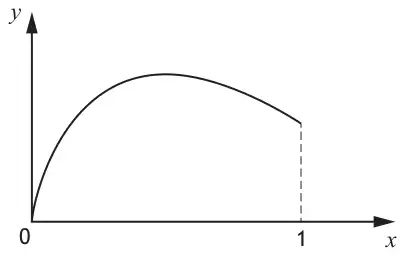
A solid is generated by rotating the curve through \(2\pi\) radians about the \(x\)-axis from \(x=0\) to \(x=1\).
(b) Calculate the exact value of the volume generated. [3]
| Mark | Generic scheme | Illustrative scheme |
|---|---|---|
| •1 | differentiate 1,2 | \(\dfrac{du}{dx}=4x\) or \(du=4x\,dx\) |
| •2 | integrate 2,3,4 | \(-\dfrac{1}{4}e^{-2x^2}+c\) |
| (2) |
Notes:
- For correct answer with no working, award 2/2.
- Where •1 has been awarded, disregard any further incorrect manipulation of the differentials provided the correct form of the integral is given.
- Disregard the omission of the constant of integration.
- Do not withhold •2 where \(du\) is incorrectly placed with respect to the integrand.
| Mark | Generic scheme | Illustrative scheme |
|---|---|---|
| •3 | state form of integral 1,2 | \(\pi\displaystyle\int_0^1 y^2\,dx\) stated or implied by •4 |
| •4 | find expression in integrable form 3,4 | \(16\pi\displaystyle\int_0^1 xe^{-2x^2}\,dx\) |
| •5 | integrate and evaluate 4 | \(4\pi\left(1-e^{-2}\right)\) |
| (3) |
Notes:
- For the award of •3, limits must appear at some point.
- For the award of •3, \(dx\) must appear at some point.
- Award •4 for \(16\pi\displaystyle\int_0^1\dfrac{x}{e^{2x^2}}\,dx\).
- Where a candidate writes \(dy\) instead of \(dx\), •4 and •5 are still available provided integration is carried out with respect to \(x\).