
May 2022 Paper 2 Q13
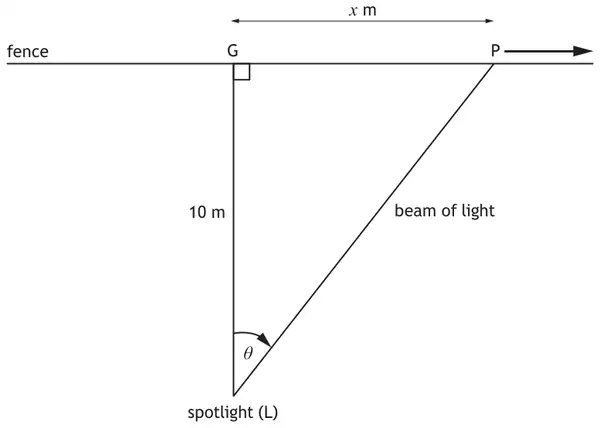
13. A security spotlight is situated 10 metres from a straight fence. The spotlight rotates at a constant speed and makes one full revolution every 12 seconds.
The situation at time \(t\) seconds is modelled in the diagram below, where:
- L is the position of the spotlight
- G is the point on the fence nearest to the spotlight
- P is the position where the light hits the fence
- \(\theta\) is the angle between LG and LP
- \(x\) is the distance in metres from G to P.
| Mark | Generic scheme | Illustrative scheme |
|---|---|---|
| •1 | full turn divided by time 1, 2 | \(\dfrac{2\pi}{12}\) leading to \(\dfrac{\pi}{6}\). |
| (1) |
Notes:
- •1 is available to candidates who work in degrees and then convert to radians.
- If \(\dfrac{2\pi}{12}\) follows directly from an incorrect assumption, eg the rate of change of \(LP\) with respect to time is a constant, then •1 is not available.
Commonly Observed Responses:
Angular velocity approach
Given that the angular velocity in this case is constant, •1 may be awarded.
\[\begin{aligned}\omega&=\dfrac{\theta}{t}\\&=\dfrac{d\theta}{dt}\\&=\dfrac{2\pi}{12}\\&=\dfrac{\pi}{6}\end{aligned}\]
| Mark | Generic scheme | Illustrative scheme |
|---|---|---|
| •2 | state relationship between derivatives | \(\dfrac{dx}{dt}=\dfrac{dx}{d\theta}\cdot\dfrac{d\theta}{dt}\) |
| •3 | find \(x\) in terms of \(\theta\) | \(x=10\tan\theta\) |
| •4 | differentiate wrt \(\theta\) 1, 2 | \(\dfrac{dx}{d\theta}=10\sec^2\theta\) stated or implied |
| •5 | substitute and simplify | \(\dfrac{dx}{dt}=10\sec^2\theta.\dfrac{\pi}{6}\) leading to \(\dfrac{dx}{dt}=\dfrac{5\pi}{3}\sec^2\theta\) |
| (4) |
Notes:
- •4 is not available for a candidate who differentiates \(x=\dfrac{5\pi}{3}\tan\theta\).
- •4 may be awarded only where a candidate differentiates a clearly defined expression for \(x\), other than \(x=\dfrac{5\pi}{3}\tan\theta\), and the differentiation is beyond Higher Mathematics standard.
| Mark | Generic scheme | Illustrative scheme |
|---|---|---|
| •6 | complete proof 1 | eg \(\begin{aligned}&1+\dfrac{\sin^2\theta}{\cos^2\theta}\\&=\dfrac{\cos^2\theta+\sin^2\theta}{\cos^2\theta}\ \text{ or }\ \dfrac{\cos^2\theta}{\cos^2\theta}+\dfrac{\sin^2\theta}{\cos^2\theta}\\&=\dfrac{1}{\cos^2\theta}\\&=\sec^2\theta\end{aligned}\) |
| (1) |
Notes:
- Accept proof using another (single) variable in place of \(\theta\).
Commonly Observed Responses:
Starting with \(\cos^2\theta+\sin^2\theta=1\)
\(\dfrac{\cos^2\theta}{\cos^2\theta}+\dfrac{\sin^2\theta}{\cos^2\theta}=\dfrac{1}{\cos^2\theta}\)
\(1+\tan^2\theta=\sec^2\theta\)
Both lines of working must be present for the award of •6
Corrected by Westie's Workshop
- The board's marking instructions printed “\(\dfrac{\sin^2\theta}{\cos\theta}\)”. Changed to “\(\dfrac{\sin^2\theta}{\cos^2\theta}\)” because every term is divided by \(\cos^2\theta\), so this denominator is \(\cos^2\theta\) too.
- The board's marking instructions printed “\(1+\tan^2 2\theta=\sec^2\theta\)”. Changed to “\(1+\tan^2\theta=\sec^2\theta\)” because the identity being proved is \(1+\tan^2\theta=\sec^2\theta\); the extra 2 is a stray character.
Original: see the board's marking instructions PDF (link above).
| Mark | Generic scheme | Illustrative scheme |
|---|---|---|
| •7 | find \(\tan\theta\) or \(\sec\theta\) | \(\tan\theta=\dfrac{5}{10}\) or \(\sec\theta=\dfrac{\sqrt{125}}{10}\) |
| •8 | corresponding value of \(\sec^2\theta\) 1 | \(1+\left(\dfrac{5}{10}\right)^2\), \(\dfrac{125}{100}\) or \(1+\left(\tan\left(\tan^{-1}\dfrac{1}{2}\right)\right)^2\) or equivalent |
| •9 | substitute and simplify 2, 3 | \(\dfrac{25\pi}{12}\) ms-1. |
| (3) |
Notes:
- Where a candidate finds and rounds an angle for \(\theta\), •8 is available only when rounding occurs to at least 2 significant figures.
- Where a candidate substitutes an angle in degrees into their calculation, withhold •9.
- Units must appear beside an exact value for the award of •9.