
May 2022 Paper 1 Q7
7.
Student engineers are using a 3D printer to make a model.
Relative to a suitable set of axes, the cross-section of the model is symmetrical about the \(y\)-axis and is represented in the first quadrant by the curve with equation \(x=\dfrac{4y}{\sqrt{y^2+1}}\), \(0\leqslant y\leqslant 5\), as shown in the diagram.
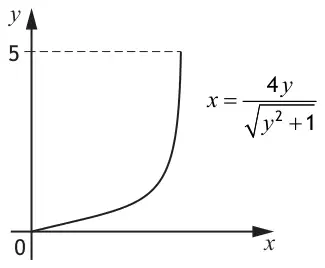
The curve \(x=\dfrac{4y}{\sqrt{y^2+1}}\), \(0\leqslant y\leqslant 5\), will be rotated through \(2\pi\) radians about the \(y\)-axis to make the model.
| Mark | Generic scheme | Illustrative scheme |
|---|---|---|
| •1 | differentiate 1 | \(\dfrac{du}{dy}=2y\) or \(du=2y\,dy\) |
| •2 | determine new limits and begin to rewrite integral 1 | \(\displaystyle\int_1^{26}\ldots du\) |
| •3 | complete integral 2 | \(2\displaystyle\int_1^{26}\dfrac{1}{\sqrt{u}}\,du\) |
| •4 | integrate and evaluate 3 | \(4\left(\sqrt{26}-1\right)\) |
| (4) |
Notes:
- Where a candidate attempts to process an integrand containing both \(u\) and \(y\), only •1 and •2 are available.
- Limits are not necessary for the award of •3.
- Where a candidate erroneously includes a limit of 0 for \(u\), •4 is not available.
Commonly Observed Responses:
A No limits in new integral and return to original variable:
| \(2\displaystyle\int\dfrac{1}{\sqrt{u}}\,du\) | award •3 |
| \(\left[4\left(y^2+1\right)^{\frac{1}{2}}\right]_0^5\) | award •2 |
B Wrong limits in new integral and return to original variable:
| \(\displaystyle\int_0^5\ldots du\) | do not award •2 |
| \(2\displaystyle\int_0^5\dfrac{1}{\sqrt{u}}\,du\) | award •3 |
| \(\left[4\left(y^2+1\right)^{\frac{1}{2}}\right]_0^5\) leading to \(4\left(\sqrt{26}-1\right)\) | award •4 |
C Wrong limits in new integral and no return to original variable:
| \(\displaystyle\int_0^5\ldots du\) | do not award •2 |
| \(2\displaystyle\int_0^5\dfrac{1}{\sqrt{u}}\,du\) | award •3 |
| \(\left[4u^{\frac{1}{2}}\right]_0^5\) | do not award •4 |
| Mark | Generic scheme | Illustrative scheme |
|---|---|---|
| •5 | obtain area 1 | \(8\left(\sqrt{26}-1\right)\) (square units) |
| (1) |
Notes:
- For a candidate who obtains a negative value at •4, •5 is available only where they interpret the area as a positive number.
| Mark | Generic scheme | Illustrative scheme |
|---|---|---|
| •6 | obtain expression 1 | \(1-\dfrac{1}{y^2+1}\) |
| (1) |
Notes:
- At •6, accept \(1+\dfrac{-1}{y^2+1}\) but do not accept \(1+-\dfrac{1}{y^2+1}\).
| Mark | Generic scheme | Illustrative scheme |
|---|---|---|
| •7 | correct form of integral 1, 2 | \(\pi\displaystyle\int_0^5 x^2\,dy\) |
| •8 | find expression in integrable form | \(16\pi\displaystyle\int_0^5\left(1-\dfrac{1}{y^2+1}\right)dy\) |
| •9 | integrate \(-\dfrac{1}{y^2+1}\) 3, 4 | \(\ldots-\tan^{-1}y\) |
| •10 | complete integration and evaluate 3, 5 | \(16\pi\left(5-\tan^{-1}5\right)\) (cubic units) |
| (4) |
Notes:
- For the award of •7:
- limits must appear at some point
- \(dy\) must appear at some point.
- At •7 accept \(V=\pi\displaystyle\int_0^5\left[f(y)\right]^2dy\).
- Where a candidate attempts to process an integrand containing both \(u\) and \(y\), •9 and •10 are unavailable.
- •9 is available only for the integration of a term of the form \(\pm\dfrac{b}{y^2+1}\), \(b\in\mathbb{R}\).
- •10 is not available where:
- the integrand at •8 is not beyond Higher Mathematics standard
- a candidate produces an undefined expression eg \(\ln 0\).
Corrected by Westie's Workshop
- The board's marking instructions printed “b ∈ □”. Changed to “b ∈ ℝ” because the printed symbol did not display (an empty box) and the set of real numbers, ℝ, is clearly meant.
Original: see the board's mark scheme PDF (link above).