
June 2022 Unit 3 Q13
13. A function is defined by \(f(x)=2x^3+3x-5\).
(a) Prove that the graph of \(f(x)\) does not have a stationary point. [2]
(b) Show that the graph of \(f(x)\) does have a point of inflection and find the coordinates of the point of inflection. [4]
(c) Sketch the graph of \(f(x)\). [1]
| Scheme | Marks | Comments |
|---|---|---|
| \(f^{\prime}(x)=6x^2+3\) | B1 | |
| Hence \(f^{\prime}(x)\gt 0\) for all \(x\), | ||
| i.e. \(f(x)\) does not have a stationary point. | E1 | oe e.g. \(f^{\prime}(x)=0\) has no real roots discriminant \(=0^2-4(6)(3)\lt 0\), no real roots |
| [2] |
| Scheme | Marks | Comments |
|---|---|---|
| \(f^{\prime\prime}(x)=12x\) | M1 | |
| At point of inflection \(f^{\prime\prime}(x)=0,\ x=0\) | m1 | |
| \(f^{\prime}(x)\gt 0\) when \(x\lt 0\) and when \(x\gt 0\). Therefore, when \(x=0\), there is a point of inflection. | A1 | oe cubic curve no max/min must have a point of inflection. OR \(x\gt 0,\ f^{\prime\prime}(x)\gt 0;\ x\lt 0,\ f^{\prime\prime}(x)\lt 0\) |
| The point of inflection is \((0,\ -5)\) | B1 | |
| [4] |
| Scheme | Marks | Comments |
|---|---|---|
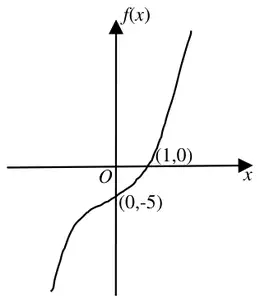 | G1 | cubic curve no max/min ft point in (b) coords not required. (1,0) not required. |
| [1] |