
June 2019 Unit 1 Q6
6. \(OABC\) is a parallelogram with \(O\) as origin.
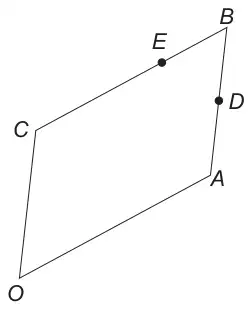
The position vector of \(A\) is \(\mathbf{a}\) and the position vector of \(C\) is \(\mathbf{c}\). The midpoint of \(AB\) is \(D\). The point \(E\) divides the line \(CB\) such that \(CE:EB=2:1\).
(a) Find, in terms of \(\mathbf{a}\) and \(\mathbf{c}\),
(i) the vector \(\mathbf{AC}\),
(ii) the position vector of \(D\),
(iii) the position vector of \(E\). [3]
(b) Determine whether or not \(DE\) is parallel to \(AC\), clearly stating your reason. [2]
| Scheme | Marks | Comments |
|---|---|---|
| (i) \(\mathbf{AC}=-\mathbf{a}+\mathbf{c}\) | B1 | |
| (ii) \(\mathbf{OD}=\mathbf{a}+\dfrac{1}{2}\mathbf{c}\) | B1 | |
| (iii) \(\mathbf{OE}=\mathbf{c}+\dfrac{2}{3}\mathbf{a}\) | B1 | any correct form |
| Scheme | Marks | Comments |
|---|---|---|
| Valid reason | M1 | ft (a) |
| Eg. \(\mathbf{DE}\neq k\mathbf{AC}\), \(\mathbf{DE}=\dfrac{1}{2}\mathbf{c}-\dfrac{1}{3}\mathbf{a}\); | ||
| or \(E\) is not the midpoint of \(CB\). | ||
| Hence \(AC\) is not parallel to \(DE\). | A1 | ft (a) |