
June 2023 Unit 2 Q11
11. A particle, which is initially at the point \(A\), travels in a straight line during the interval \(0\leqslant t\leqslant 22\), where \(t\) is the time in seconds. The diagram below shows a velocity-time graph for the motion of the particle. The velocity of the particle when \(t=18\) is \(V\text{ ms}^{-1}\).
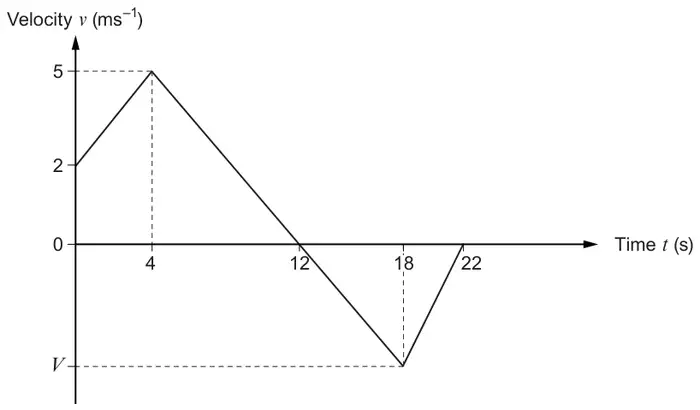
(a) Find the acceleration of the particle when \(t=1\). [2]
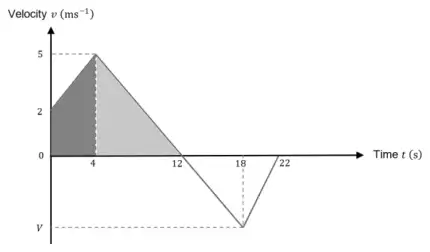
(b) Calculate the distance travelled by the particle during the interval \(0\leqslant t\leqslant 12\). [2]
(c) When \(t=22\), the displacement of the particle from \(A\) is \(14\text{ m}\). Determine the value of \(V\). [3]
(d) Write down the time interval during which the particle is moving towards \(A\) and its speed is increasing. [1]
| Scheme | Marks | Comments |
|---|---|---|
| At \(t=1\), acceleration = gradient \(=\dfrac{5-2}{4-0}\) | M1 | |
| \(=\frac{3}{4}\) or \(0{\cdot}75\) \((\text{ms}^{-2})\) | A1 | cao |
| [2] |
Alternative Solution
| Scheme | Marks | Comments |
|---|---|---|
| \(v=u+at,\ \ u=2,v=5,t=4\) \(5=2+a(4)\) | (M1) | Used |
| \(a=\frac{3}{4}\) or \(0{\cdot}75\) \((\text{ms}^{-2})\) | (A1) | cao |
| ([2]) |
Corrected by Westie's Workshop
- The board's mark scheme printed “\((\text{ms}^{-1})\)”. Changed to “\((\text{ms}^{-2})\)” because this is an acceleration, which is measured in \(\text{ms}^{-2}\) (as in the main method).
Original: see the board's mark scheme PDF (link above).
| Scheme | Marks | Comments |
|---|---|---|
| Distance = area \(=\frac{1}{2}(2+5)(4)+\frac{1}{2}(8)(5)\) | M1 | Attempt to find relevant area |
| \(=34\) (m) | A1 | cao |
| [2] |
| Scheme | Marks | Comments |
|---|---|---|
| area below \(t\) – axis \(=34-14\) | M1 | FT distance in b) |
| \(\pm\frac{1}{2}(10V)=\pm(34-14)\) | m1 | |
| \(V=-4\) | A1 | cao |
| [3] |
| Scheme | Marks | Comments |
|---|---|---|
Correct statement, for example
| B1 | Statement (mathematical or otherwise) to the effect that interval is between the given boundaries. |
| [1] | ||
| Total for Question | 8 |