
June 2023 Unit 2 Q9
9. Three forces \(\mathbf{F}\), \(\mathbf{G}\) and \(\mathbf{H}\) are such that
\[\mathbf{F}=(2\mathbf{i}-13\mathbf{j})\text{ N},\qquad \mathbf{G}=(-6\mathbf{i}+8\mathbf{j})\text{ N},\qquad \mathbf{H}=(12\mathbf{i}+k\mathbf{j})\text{ N},\]where \(k\) is a constant. The resultant of the three forces, \(\mathbf{R}\), has magnitude \(17\text{ N}\).
(a) Find the two possible values of the constant \(k\). [4]
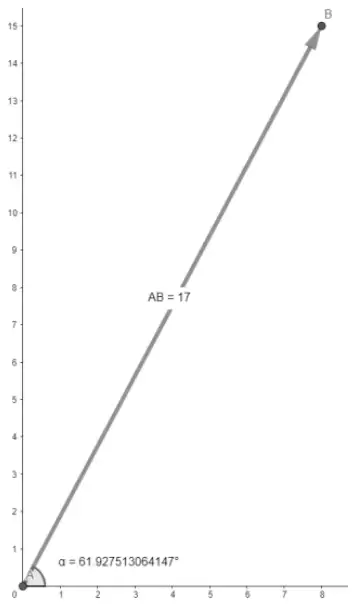
(b) For the larger of the two values of \(k\), calculate the angle that \(\mathbf{R}\) makes with the \(\mathbf{i}\) vector. [2]
| Scheme | Marks | Comments |
|---|---|---|
| \(\mathbf{R}=\mathbf{F}+\mathbf{G}+\mathbf{H}\) \(=(2\mathbf{i}-13\mathbf{j})+(-6\mathbf{i}+8\mathbf{j})+(12\mathbf{i}+k\mathbf{j})\) | M1 | |
| \(=8\mathbf{i}+(k-5)\mathbf{j}\) | A1 | |
| \(|\mathbf{R}|=17\) \(\sqrt{8^2+(k-5)^2}=17\) \(k-5=\pm 15\) | M1 | |
| \(k=-10,20\) | A1 | cao, both values |
| [4] |
| Scheme | Marks | Comments |
|---|---|---|
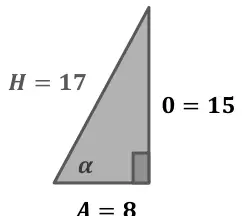
| For larger \(k=20\), \(\mathbf{R}=8\mathbf{i}+(20-5)\mathbf{j}=8\mathbf{i}+15\mathbf{j}\) | \(\sin\alpha=\frac{15}{17}\) \(\cos\alpha=\frac{8}{17}\) \(\tan\alpha=\frac{15}{8}\) | |
| Let \(\alpha\) be angle that \(\mathbf{R}\) makes with the \(\mathbf{i}\) vector Accept any of the following ratios \(\sin\alpha=\frac{15}{17}\ \ \left(=\frac{8}{17}\right)\) \(\cos\alpha=\frac{8}{17}\ \ \left(=\frac{15}{17}\right)\) \(\tan\alpha=\frac{15}{8}\ \ \left(=\frac{8}{15}\right)\) | M1 | FT their derived value of \(k\) \(\sin\alpha=\frac{k-5}{17}\ \ \left(=\frac{8}{17}\right)\) \(\cos\alpha=\frac{8}{17}\ \ \left(=\frac{k-5}{17}\right)\) \(\tan\alpha=\frac{k-5}{8}\ \ \left(=\frac{8}{k-5}\right)\) |
| \((90-28{\cdot}0(724\ldots)^\circ)\) \(\alpha=61{\cdot}9(275\ldots)^\circ\) | A1 | cao |
| [2] | ||
| Total for Question | 6 |