
June 2024 Unit 1 Q18
18.
(a) A circle C has centre (–3, –1) and radius \(\sqrt{5}\). Show that the equation of C can be written as \(x^2+y^2+6x+2y+5=0\). [2]
(b)
(i) Find the equations of the tangents to C that pass through the origin O. [6]
(ii) Determine the coordinates of the points where the tangents touch the circle. [4]
| Scheme | Marks | Comments |
|---|---|---|
| \((x--3)^2+(y--1)^2=\left(\sqrt{5}\right)^2\) | M1 | condone \(\sqrt{5}\) on RHS |
| \((x+3)^2+(y+1)^2=5\) \(x^2+6x+9+y^2+2y+1=5\) | ||
| \(x^2+y^2+6x+2y+5=0\) | A1 | convincing |
Alternative (OR)
| Scheme | Marks | Comments |
|---|---|---|
| Equation of circle radius \(r\) is \(x^2+y^2+2fx+2gy+c=0\) | ||
| Centre \((-f,-g)\), \(c=f^2+g^2-r^2\) | (M1) | used |
| \(f=3,\ g=1,\ c=3^2+1^2-\sqrt{5}^2=5\) | (A1) |
Alternative (OR)
| Scheme | Marks | Comments |
|---|---|---|
| \(x^2+y^2+6x+2y+5=0\) | ||
| \((x+3)^2+(y+1)^2-9-1+5=0\) | (M1) | M0 if no working shown. |
| \((x+3)^2+(y+1)^2=5\) | ||
| Hence centre = (−3, −1), radius \(=\sqrt{5}\) | (A1) |
| Scheme | Marks | Comments |
|---|---|---|
| (i) Tangents have equations \(y=mx\) | B1 | |
| Touches circle when \(x^2+(mx)^2+6x+2mx+5=0\) | M1 | |
| \((1+m^2)x^2+2(3+m)x+5=0\) | A1 | si |
| Discriminant \(=4(3+m)^2-4(1+m^2)\times5\) | B1 | ft 1 slip in quadratic |
| If tangent, discriminant \(=0\) | M1 | used |
| \(9+6m+m^2-5-5m^2=0\) \(2m^2-3m-2=0\) \((2m+1)(m-2)=0\) | ||
| \(m=-\frac{1}{2}\qquad m=2\) \(y=-\frac{1}{2}x\qquad y=2x\) | A1 | cao, both values |
| (ii) \(m=-\frac{1}{2},\ \frac{5}{4}x^2+5x+5=0\) | M1 | FT their derived \(m\) provided \(y=mx\) |
| \(x^2+4x+4=0\) | ||
| \((x+2)^2=0\) | m1 | must be a perfect square, si |
| \(x=-2,\ y=1\quad(-2,\ 1)\) | A1 | cao |
| \(m=2,\ 5x^2+10x+5=0\) | (M1) | award if previous M1 not awarded |
| \(x^2+2x+1=0\) | ||
| \((x+1)^2=0\) | (m1) | must be a perfect square, si |
| \(x=-1,\ y=-2\quad(-1,\ -2)\) | A1 | cao |
Notes (i)
Special case 1
Candidates who substitute \(y=mx+c\) can only earn method marks, B0 M1 A0 B0 M1 A0
Special case 2
Candidates who obtain the correct answer using any method, award as follows:
| Scheme | Marks | Comments |
|---|---|---|
| \(y=-\frac{1}{2}x\quad y=2x\) | SC1 |
Alternative solution (i)
| Scheme | Marks | Comments |
|---|---|---|
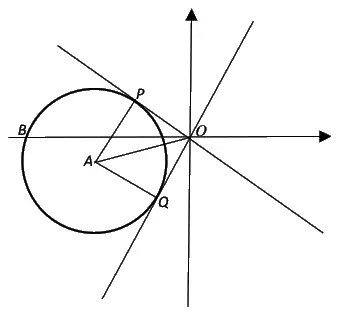 | ||
| \(\tan(BOA)=\frac{1}{3}\) | ||
| \(BOA=18.43494882^\circ\) | B1 | \(BOP=26.56505118^\circ\) |
| \(OA=\sqrt{(3)^2+(1)^2}=\sqrt{10}\) | B1 | |
| \(OP=OQ=\sqrt{\left(\sqrt{10}\right)^2-\left(\sqrt{5}\right)^2}=\sqrt{5}\) | B1 | |
| Triangle \(POA\) and \(QOA\) are isosceles right angled | ||
| Angles \(POA=45^\circ\) and \(QOA=45^\circ\) | B1 | |
| Gradient \(OQ=\tan(45+18.43494882)=2\) \(y=2x\) | B1 | tan(243. 43494882) = 2 |
| Gradient \(OP=-\frac{1}{2}\) \(y=-\frac{1}{2}x\) | B1 | \(\tan(26.56505118)=\frac{1}{2}\) \(\tan(153.43494882)=-\frac{1}{2}\) |
Alternative (OR) (ii)
| Scheme | Marks | Comments |
|---|---|---|
| \(x=\dfrac{-b}{2a}=\dfrac{-2(3+m)}{2(1+m^2)}=\dfrac{-(3+m)}{(1+m^2)}\) | (M1) | |
| At \(m=-\frac{1}{2}\), \(x=\dfrac{-\left(3-\frac{1}{2}\right)}{\left(1+\frac{1}{4}\right)}=-2\) | (m1) | |
| \(y=-\frac{1}{2}\times(-2)=1\qquad(-2,\ 1)\) | (A1) | |
| At \(m=2\), \(x=\dfrac{-(3+2)}{(1+4)}=-1\) | ||
| \(y=2\times(-1)=-2\qquad(-1,\ -2)\) | (A1) |
Special case (ii)
Candidates who obtained the correct answer using any method, award as follows:
| Scheme | Marks | Comments |
|---|---|---|
| \((-2,\ 1)\quad(-1,\ -2)\) | SC1 |
Corrected by Westie's Workshop
- The board's mark scheme printed “\(\tan(116.56505118)=-\frac{1}{2}\)”. Changed to “\(\tan(153.43494882)=-\frac{1}{2}\)” because \(\tan 116.565^\circ=-2\), not \(-\frac{1}{2}\). The line \(OP\) makes \(180^\circ-26.565^\circ=153.435^\circ\) with the positive \(x\)-axis, and \(\tan 153.435^\circ=-\frac{1}{2}\).
Original: see the board's mark scheme PDF (link above).