
May 2025 Paper 1 Q15
15. The diagrams of a rectangle and square are shown below.
All measurements are in centimetres.
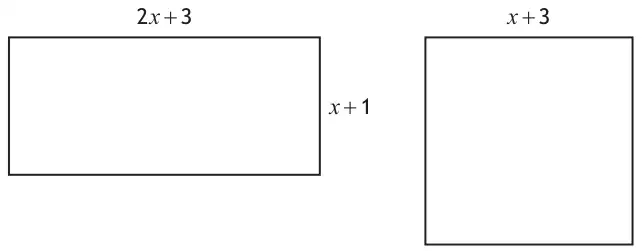
(a) Find an expression for the area of the rectangle. [1]
(b) Given that the area of the rectangle is equal to the area of the square, show that \(x^2-x-6=0\). [2]
(c) Hence find, algebraically, the length and breadth of the rectangle. [3]
| Mark | Generic scheme | Illustrative scheme |
|---|---|---|
| •1 | find expression for area of rectangle | \((2x+3)(x+1)\) or equivalent |
| (1) |
Notes:
- If no expression is given in (a) but appears in (b) or (c). award 1/1
- (a) accept \((2x+3)\times(x+1)\) or \(2x+3\times x+1\).
(b) do NOT accept \(2x+3\times(x+1)\) or \((2x+3)\times x+1\) unless the correct expansion appears in parts (a), (b) or (c). - Do not penalise incorrect simplification or expansion of brackets in (a).
| Mark | Generic scheme | Illustrative scheme |
|---|---|---|
| •2 | equate required expressions and expand expression for area of square or rectangle within the equation | \(2x^2+2x+3x+3=(x+3)^2\) OR \((2x+3)(x+1)=x^2+3x+3x+9\) |
| •3 | complete expansion and rearrange into required form | \(2x^2+2x+3x+3=x^2+3x+3x+9\) \(\Rightarrow x^2-x-6=0\) |
| (2) |
Notes:
- If solution to (b) appears in (a) or (c) then both marks are available.
| Mark | Generic scheme | Illustrative scheme |
|---|---|---|
| •4 | factorise \(x^2-x-6\) | \((x-3)(x+2)\) |
| •5 | solve equation | \((x=)\,3,\ (x=)\,{-2}\) |
| •6 | reject invalid value of \(x\) and state length and breadth of rectangle | 9 (cm) and 4 (cm) |
| (3) |
Notes:
- Correct answer without working. award 0/3
- If solution to (c) appears in (a) or (b) then all three marks are available.
However, if a different value for \(x\) is stated in (c) then •6 is not available.
(General Marking Principle (l) should not be applied in this special case.) - •4 is available for \(\dfrac{1\pm\sqrt{25}}{2}\).
- For an answer obtained by repeated substitution. award 0/3
Commonly Observed Responses:
- (a) \((2x+3)(x+1)=0\to x=-\dfrac{3}{2},\ x=-1\) award 1/3 ✗✓1✗
(b) \(x=-\dfrac{3}{2},\ x=-1\) without factorised quadratic equation stated award 0/3