
Higher November 2017 Paper 2 Q14
14. Beth is making some designs using small square tiles.
She labels the patterns, as shown below.
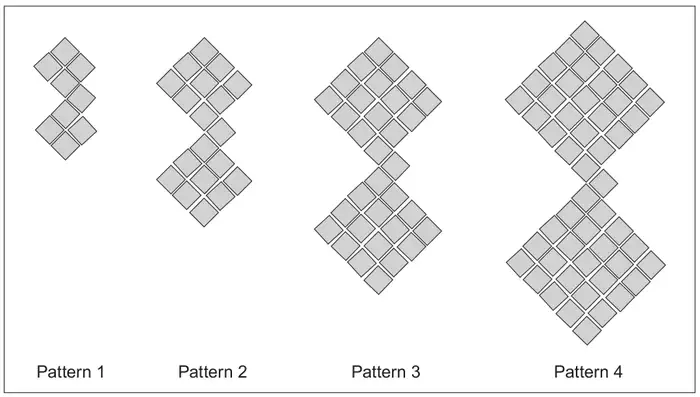
(a) Beth has a further 75 small square tiles.
How many tiles will Beth have left after making Pattern 5? [2]
How many tiles will Beth have left after making Pattern 5? [2]
(b) Write an expression for the number of small square tiles in Pattern \(n\). [2]
(c) Show that Beth cannot make a complete design using exactly 796 tiles. [1]
| Scheme | Marks | Comments |
|---|---|---|
| 2 (tiles left over) | B2 | B1 for (Pattern 5 uses) 73 (tiles) or \(75 - (2 \times 6^2 + 1)\) |
| Scheme | Marks | Comments |
|---|---|---|
| \(2(n + 1)^2 + 1\) or \(2n^2 + 4n + 3\) or equivalent | B2 | ISW B1 for sight of \((n + 1)^2\) or equivalent or for sight of \(2n^2\) |
| Scheme | Marks | Comments |
|---|---|---|
| Demonstrates correctly, e.g. \(2 \times 20^2 + 1 = 801\) and \(2 \times 19^2 + 1 = 723\), OR (omitting the +1), considering \(2 \times 19^2 = 722\) and \(2 \times 20^2 = 800\), OR \((n + 1)^2 = 397.5\) with an indication that \(n\) cannot be a whole number, OR statement that complete designs all have an odd number of tiles, i.e. ‘796 is not odd and all designs use an odd number of tiles’, or ‘796 is even and all designs use an odd number of tiles’ OR \(2n^2 + 4n + 3 = 796\) so \(2n^2 + 4n - 793 = 0\) with substitution of \(n = 18\) to give \(-73\), \(n = 19\) to give 5 | B1 | |
| (5) |