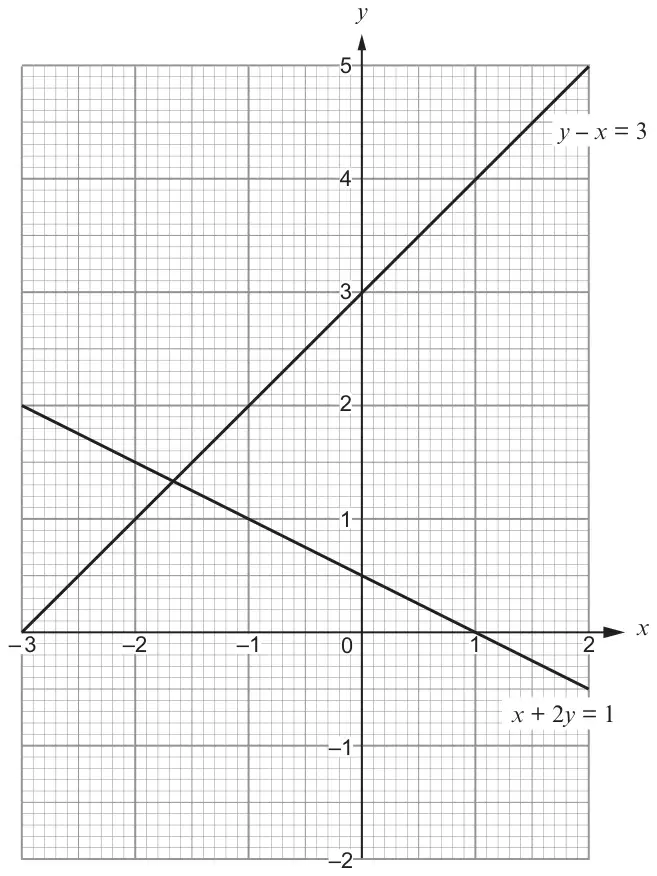
(a)Use the diagram to solve the simultaneous equations \[y - x = 3,\] \[x + 2y = 1.\] Give your answers correct to 1 decimal place. [2]
(b) A theme park sells entrance tickets.
2 adult tickets and 3 child tickets would cost a total of £72. 3 adult tickets and 1 child ticket would cost a total of £66.
A family ticket costs £45 and allows entry for 2 adults and 2 children.
How much cheaper is it to buy a family ticket than it would be to buy 2 adult and 2 child tickets? [5]
Mark scheme (a)
Scheme
Marks
Comments
\(x = -1.6\) or \(-1.7\)
B1
\(y = 1.3\) or \(1.4\)
B1
If no marks then SC1 for a value of \(x\) between \(-1.6\) and \(-1.7\) and a value of \(y\) between 1.3 and 1.4 or for correct values given as coordinates
Mark scheme (b)
Scheme
Marks
Comments
\(2a + 3c = 72\) and \(3a + c = 66\)
B1
May use other letters or words throughout this part
Method to eliminate an unknown e.g. equal coefficients and subtraction
M1
FT their equations provided one is correct and the other is linear in the same pair of unknowns
or rearranges one equation and substitutes into the other
Allow one error in one term, not in the equated coefficients
Finds one unknown
A1
CAO; \(a = 18\) or \(c = 12\)
Finds the other unknown
A1
FT ‘their \(a\)’ or ‘their \(c\)’ used in one of their equations
(£)15(.00)
B1
FT 2(‘their derived \(a\)’) + 2(‘their derived \(c\)’) – 45 provided 2(‘their derived \(a\)’) + 2(‘their derived \(c\)’) is greater than 45
(7)
Alternative method
Scheme
Marks
Comments
Adult ticket costs £18, child ticket costs £12 found using trials
B4
(£)15(.00)
B1
FT 2(‘their derived \(a\)’) + 2(‘their derived \(c\)’) – 45 provided 2(‘their derived \(a\)’) + 2(‘their derived \(c\)’) is greater than 45
We'd like to use Google Analytics cookies to count visits and see which pages help most. They're optional, and the site works exactly the same either way. Privacy policy