one correct equation and a correct but incomplete rearrangement of the other seen e.g. \(y = 4x - 6{\cdot}5\) and \(3y = 12x + 9\)
both in the form \(y = 4x + c\) with an error in one constant term, provided constants aren’t equal. e.g \(y = 4x - 6{\cdot}5\) and \(y = 4x + 9\)
B1 for:
one correct equation \(y = 4x - 6.5\) or \(y = 4x + 3\)
two equations of the form \(y = 4x + \ldots\) with errors in both constant terms or no constant terms.
Allow all marks for equivalent complete methods e.g. \(6y - 24x = 18\) AND \(6y - 24x = -39\) or (\(3y = 12x + 9\) AND \(3y = 12x - 19.5\)) and a clear statement that the two equations are of the same form and the only difference is the constant, so they are parallel.
Corrected by Westie's Workshop
The board's mark scheme printed “or or”. Changed to “or” because the word “or” was printed twice.
Original: see the board's mark scheme PDF (link above).
Mark scheme (b)
Scheme
Marks
Comments
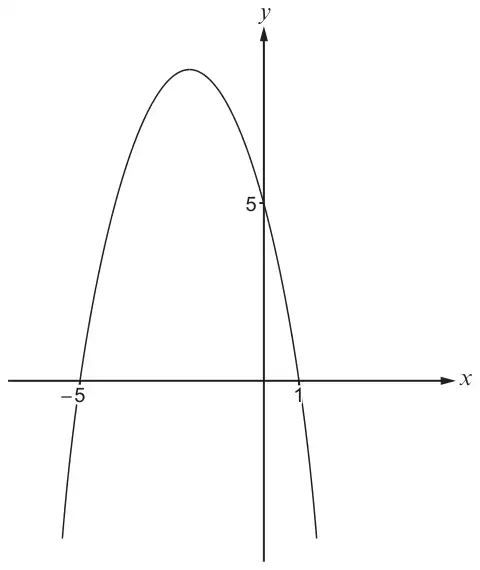
(−2, 9)
B2
B1 for each
If no final coordinate given, award B2 for an unambiguous \(x = -2\) and \(y = 9\) seen in working
B1 for one of \(x = -2\) or \(y = 9\) seen in working
We'd like to use Google Analytics cookies to count visits and see which pages help most. They're optional, and the site works exactly the same either way. Privacy policy