18. A pet hotel is allowed to have a maximum of 10 pets at one time. It takes only cats and dogs. Each cat requires 1 unit of accommodation and each dog requires 3 units of accommodation. For the hotel to make a profit, there must be at least 15 units occupied each day.
Let \(x\) be the number of cats and \(y\) the number of dogs in the pet hotel.
(a) Two inequalities that represent this information are \(x\geqslant0\) and \(y\geqslant0\). Write down twofurther inequalities that represent the information. [2]
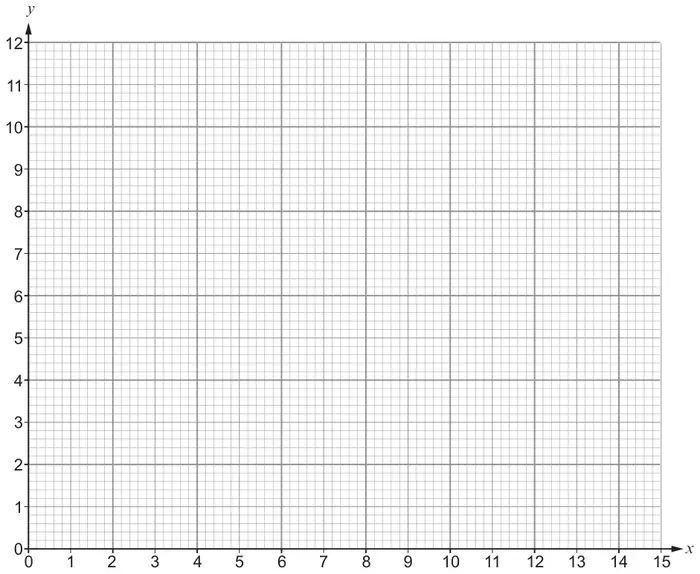
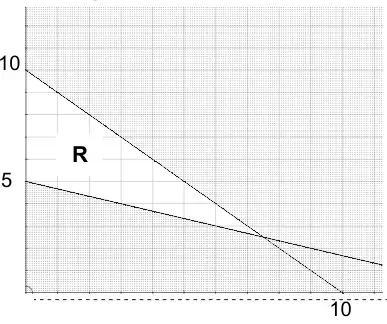
(b) On the graph paper below, draw the region that satisfies all of these inequalities. Indicate clearly the region that is your answer. [3]
(c) One Wednesday there are enough pets staying for the hotel to make a profit. What is the fewest number of dogs that could be in the hotel? [1]
Mark scheme (a)
Scheme
Marks
Comments
\(x+y\leqslant10\)
B1
Allow the use of other variables e.g. c and d
\(x+3y\geqslant15\)
B1
If no marks award SC1 if both inequalities are only inaccurate due to incorrect inequality signs.
Mark scheme (b)
Scheme
Marks
Comments
Line \(x+y=10\) drawn
B1
FT ‘their linear inequalities’ (if they give equations of the form \(ax+by=c\)) where possible
Line \(x+3y=15\) drawn
B1
Correct region indicated
B1
FT if closed region Do not penalise omission of the line x = 0 unless the area to the left of the axis is clearly included in the required region.
We'd like to use Google Analytics cookies to count visits and see which pages help most. They're optional, and the site works exactly the same either way. Privacy policy