
Higher June 2024 Paper 2 Q5
5. When a ball is dropped, the maximum height it reaches after each bounce decreases.
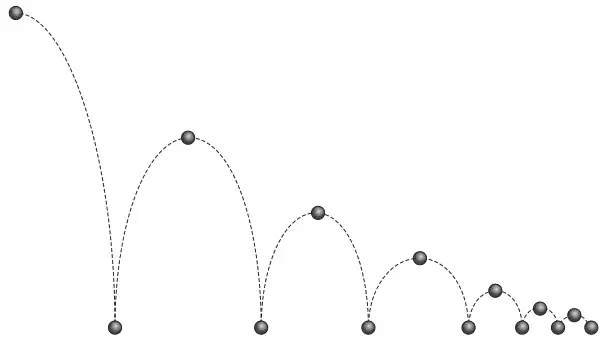
Diagram not drawn to scale
Maddox says,
“Each time the ball bounces it reaches a height that is 55% of the maximum height reached on its previous bounce.”
(a) The ball is dropped from a height of 4 m.
What height will the ball reach above the ground after its 7th bounce? [3]
What height will the ball reach above the ground after its 7th bounce? [3]
(b)
(i) State any assumptions you have made in answering part (a). [1]
(ii) What effect could your assumption have on your answer to part (a)? [1]
| Scheme | Marks | Comments |
|---|---|---|
| \(4\times0.55^7\) \(400\times0.55^7\) | M2 | M1 for \(4\times0.55^n\) or \(400\times0.55^n\) where \(1 \leqslant n \lt 9\) |
| = 0.06089…. or 0.0609 (m) 6.089….. or 6.09 (cm) | A1 | CAO. If units are given they must be correct Mark final answer. Accept 0.061 or 0.06 (m), 6.1 or 6 (cm) from correct working provided no inaccurate working seen. If no marks, award SC1 for an answer of 0.0149.. or 0.015 (m) or 1.49.. (cm) or 1.5 (cm) (from \(4\times0.45^7\) or \(400\times0.45^7\)) |
| Scheme | Marks | Comments |
|---|---|---|
| (b)(i) A correct assumption e.g. ‘The surface it bounces on is the same on each bounce.’ ‘The ball bounces on level ground.’ ‘That the 55% is correct for all bounces.’ ‘No energy is lost elsewhere.’ ‘There is no wind.’ ‘There was nothing in the way.’ | E1 | Allow e.g. 'It is flat.' – implies the surface ‘No other forces acting on the ball.’ ‘Nothing interfered with the bouncing.’ Do not allow e.g. 'It was dropped without force. ' 'The ball is dropped with the same force every time.' |
| (b)(ii) A correct effect of the assumption e.g. ‘There will be no change to my answer.’ | E1 | If no valid assumption is made, then this mark cannot be awarded. Cannot award E0 E1. The effect must follow their assumption. |
| (5) |