
Higher June 2024 Paper 1 Q24
24.
(a) The diagram below shows a sketch of \(y = f(x)\).
The point \(A\) has the coordinates \((-2,0)\).
On the same diagram, sketch \(y = f(x - 3)\).
Mark clearly the new coordinates of point \(A\). [2]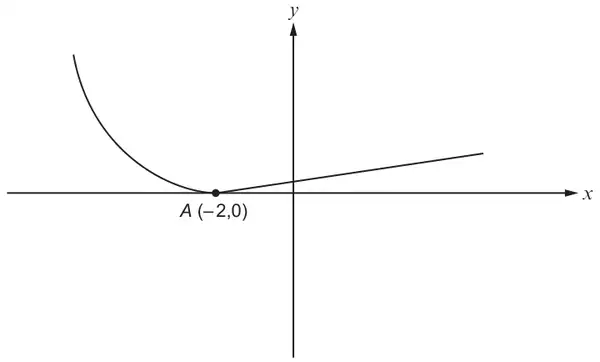
The point \(A\) has the coordinates \((-2,0)\).
On the same diagram, sketch \(y = f(x - 3)\).
Mark clearly the new coordinates of point \(A\). [2]
(b) The diagram below shows a sketch of \(y = g(x)\).
On the same diagram, sketch \(y = -g(x) + 5\).
Mark clearly the coordinates of the point where this sketch intersects an axis. [3]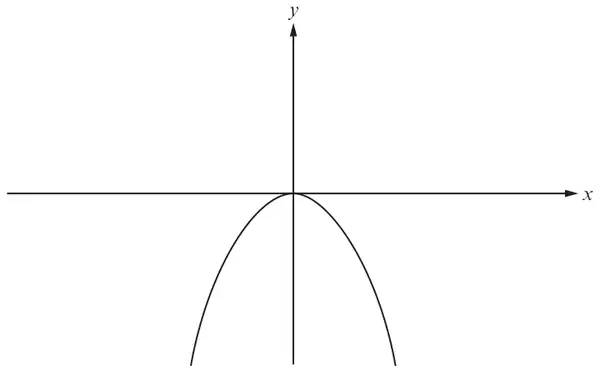
On the same diagram, sketch \(y = -g(x) + 5\).
Mark clearly the coordinates of the point where this sketch intersects an axis. [3]
| Scheme | Marks | Comments |
|---|---|---|
| Translation through \(\begin{pmatrix}k\\0\end{pmatrix}\), where \(k \gt 0\) | B1 | Allow intention of correct shape |
Minimum point labelled (1, 0) or scale marked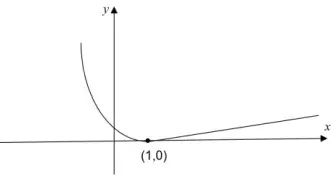 | B1 | IF no marks award SC1 for a correct sketch of y = f(x+3) with minimum point labelled (-5, 0) or scale marked |
| Scheme | Marks | Comments |
|---|---|---|
| Reflection in the x-axis | B1 | Allow intention of correct shape. Allow this B1 for an inverted curve of the correct shape. |
| Translation through \(\begin{pmatrix}0\\k\end{pmatrix}\), where \(k \gt 0\) | B1 | Allow B1 for translation of \(y = g(x)\) by \(\begin{pmatrix}0\\5\end{pmatrix}\) with maximum point labelled (0,5) or scale marked |
Minimum point labelled at (0,5) or scale marked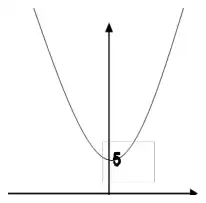 | B1 | CAO. |
| (5) |