(i) Write down the next term in the following sequence. [1]
3, 12, 48, 192, …
(ii) Write down the rule for continuing the following sequence. [1]
\(-3\), \(-11\), \(-19\), \(-27\), …
(b)
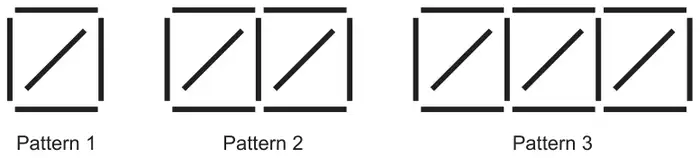
Patterns are made using sticks. The first three patterns in a sequence are shown below.
Hugo says,
The number of sticks in pattern 7 is 35 because there are 5 sticks in pattern 1 and 5 × 7 = 35.
Is Hugo correct?
Yes ☐ No ☐
Give the reason for your answer. [1]
Mark scheme (a)
Scheme
Marks
Comments
(i) 768
B1
(ii) Subtract 8 (each time)
B1
Allow -8, ‘minus 8’, ‘take away 8’ and ‘going down by 8’ OR -8n + 5
Do not allow ‘a difference of 8’ or n = -8
Mark scheme (b)
Scheme
Marks
Comments
No, indicated or implied with an appropriate reason e.g.
‘Only 4 sticks are added to make the next pattern (not 5).’ ‘The sticks increase by 4 each time.’ ‘It should be 29 sticks.’ ‘The nth term is 4n + 1 (not 5n).’
Pattern 7 drawn correctly AND they have stated it is not 35 sticks, or it is 29 sticks.
E1
Allow e.g. ‘It’s not 5 per pattern.’ ‘They do not go up by 5 each time.’ ‘5 × 2 = 10 but the second pattern only has 9 sticks (so not going up in 5’s).’ ‘Pattern 3 has 13 sticks and 13 isn’t part of the 5 times table.’
Do not allow e.g. ‘The second pattern only has 9 sticks.’ ‘A stick is shared (without further explanation).’
We'd like to use Google Analytics cookies to count visits and see which pages help most. They're optional, and the site works exactly the same either way. Privacy policy