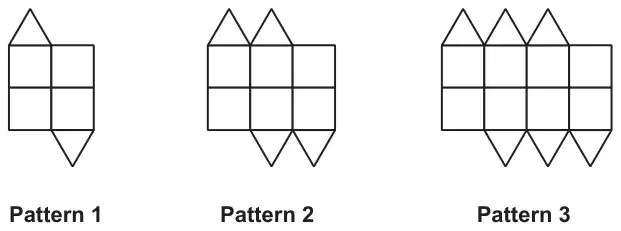
The following sequence of patterns is made using squares and triangles.
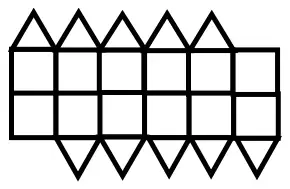
(i) Draw Pattern 5 in the space below. [1]
(ii)
Is it possible for one of the patterns in the sequence to have 23 squares and 21 triangles? Give a reason for your answer. [1]
Yes ☐ No ☐
(iii) Write down the \(n\)th term for the number of squares in the pattern. [2]
(b) The \(n\)th term of a different sequence is \(4n - 5\). Write down the first 3 terms of the sequence. [2]
Mark scheme (a)
Scheme
Marks
Comments
(i) A correct diagram for pattern 5
B1
Allow a good freehand drawing. Must see internal lines.
(ii) No, indicated with a correct explanation e.g.
‘The number of squares and triangles are always even’ ‘These are odd numbers.’ ‘The number of squares must be even.’ ‘The number of triangles must be even.’ ‘23 and 21 are not in the 2 times table.’ ’23 is an odd number.’ ’21 is an odd number.’ ‘They are not multiples of 2.’
E1
Allow e.g.
‘There would be 1 square left over.’ ‘There would be 1 triangle left over.’ ‘There will not be an equal number of triangles on the top and bottom.’ ‘There will not be an equal number of squares on the top and bottom.’ ‘There needs to be one more of each.’
Do not allow ‘It is going up in 2’s.’ ‘The number of squares and triangles are equal.’ ‘There will always be two more squares than triangles.’
(iii) \(2n + 2\) or \(2(n + 1)\)
B2
Condone the use of other letters e.g. \(2x + 2\) B1 for n2 + 2 or \(2n \pm k\) where \(k \neq 0\)
Mark scheme (b)
Scheme
Marks
Comments
\(-1\), 3 and 7
B2
Allow in any order. B1 for one of the following:
Any two of \(-1\), 3, and 7 as the first 3 terms e.g. \(-5\), \(-1\), 3
We'd like to use Google Analytics cookies to count visits and see which pages help most. They're optional, and the site works exactly the same either way. Privacy policy