
4400 Foundation November 2005 Paper 1 Q12
12 This rule can be used to work out the number of litres of paint needed to cover the walls of a room, using the length, width and height, in metres, of the room.
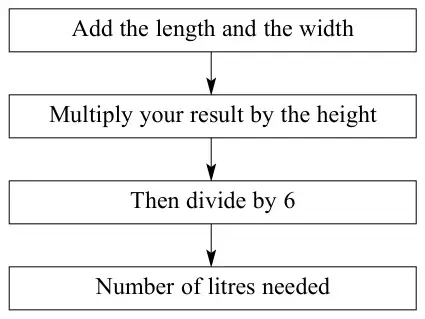
The length of a living room is 8 m.
Its width is 4 m and its height is 3 m.
The length of a bedroom is 6 m and its width is 4 m.
5 litres of paint are needed to cover the walls of the bedroom.
The length of a bathroom is 5.5 m.
Its height is 2.4 m.
4 litres of paint are needed to cover the walls of the bathroom.
A room has length \(L\) metres, width \(W\) metres and height \(H\) metres.
\(N\) litres of paint are needed to cover the walls of the room.
| Scheme | Marks |
|---|---|
| \((8 + 4) \times 3 \div 6\) | M1 |
| 6 | A1 |
| (2) |
Notes
A1: cao
No official mark scheme was available for this paper; this one was written by Westie's Workshop.
| Scheme | Marks |
|---|---|
| \(5 \times 6 \div (6 + 4)\) or \(30 \div 10\) | M1 |
| 3 | A1 |
| (2) |
Notes
A1: cao
No official mark scheme was available for this paper; this one was written by Westie's Workshop.
| Scheme | Marks |
|---|---|
| \(4 \times 6 \div 2.4\) or 10 | M1 |
| 4.5 | A1 |
| (2) |
Notes
M1: for working back through the rule as far as 10
A1: cao
No official mark scheme was available for this paper; this one was written by Westie's Workshop.
| Scheme | Marks |
|---|---|
| \(N = \dfrac{H(L + W)}{6}\) oe | B1 B2 |
| (3) | |
| (9 marks) |
Notes
B1: for \(N\) = expression with \(L, W, H\)
B2: for \(\dfrac{H(L + W)}{6}\) oe (B1 for \(\dfrac{L + WH}{6}\), \(L + \dfrac{WH}{6}\) etc)
Mark scheme taken from the matching question on the Higher paper.