
1MA0 Higher November 2012 Paper 2 Q21
21 Here are seven tiles.

Jim takes at random a tile.
He does not replace the tile.
Jim then takes at random a second tile.
(a) Calculate the probability that both the tiles Jim takes have the number 1 on them. (2)
(b) Calculate the probability that the number on the second tile Jim takes is greater than the number on the first tile he takes. (3)
| Working | Answer | Mark | Notes |
|---|---|---|---|
| \(\dfrac{2}{7} \times \dfrac{1}{6}\) OR 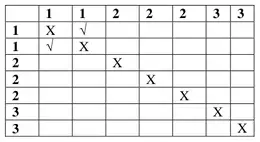 | \(\dfrac{2}{42}\) | 2 | M1 \(\dfrac{2}{7} \times \dfrac{1}{6}\) A1 \(\dfrac{2}{42}\) oe OR M1 Fully correct sample space with the correct cases identified A1 \(\dfrac{2}{42}\) oe SC : B1 for an answer of \(\dfrac{4}{49}\) |
| Working | Answer | Mark | Notes |
|---|---|---|---|
| \(\dfrac{2}{7} \times \dfrac{5}{6} + \dfrac{3}{7} \times \dfrac{2}{6}\) OR 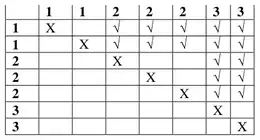 | \(\dfrac{16}{42}\) | 3 | M1 for identifying all 3 possibilities of (1,2) and (1,3) and (2,3) OR at least one of \(\frac{2}{7} \times \frac{3}{6}\) (1, 2) or \(\frac{2}{7} \times \frac{2}{6}\) (1, 3) or \(\frac{3}{7} \times \frac{2}{6}\) (2, 3) or \(\frac{2}{7} \times \frac{5}{6}\) (1, 2 or 3) M1 \(\frac{2}{7} \times \frac{5}{6} + \frac{3}{7} \times \frac{2}{6}\) or \(\frac{2}{7} \times \frac{3}{6} + \frac{2}{7} \times \frac{2}{6} + \frac{3}{7} \times \frac{2}{6}\) A1 \(\frac{16}{42}\) oe OR M2 Fully correct sample space with the correct cases identified (M1 for 1,2 and 1,3 and 2,3 identified on a sample space) A1 \(\frac{16}{42}\) oe SC: B2 for an answer of \(\frac{16}{49}\) |