
4MA0 Higher January 2014 Paper 4 Q12
12
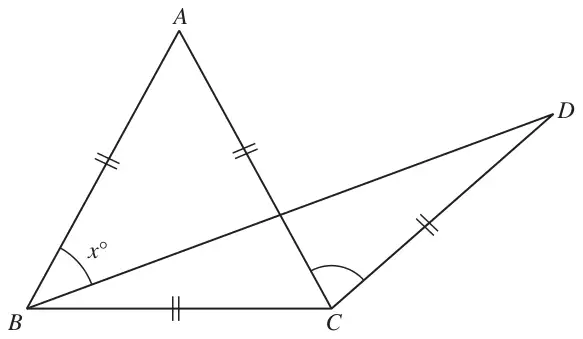
Diagram NOT accurately drawn
The diagram shows an equilateral triangle \(ABC\) and an isosceles triangle \(BCD\).
\(AB = AC = BC = CD\).
Angle \(ABD = x^\circ\)
Express the size of angle \(ACD\) in terms of \(x^\circ\), giving your answer as simply as possible.
Give a reason for each step in your working.
(4)
| Scheme | Marks |
|---|---|
| (DBC =) 60 – x (Angles in an) equilateral triangle (= 60 degrees) | B1 |
| BDC = 60 – x or BCD = 60 + 2x oe Base/bottom angles in an isosceles triangle (are equal) | B1 B1 |
| (BCD =) 60 + 2x Answer: \(2x\) | B1 |
| (4) | |
| (4 marks) |
Notes
B1: Can be marked on diagram.
{Reason 1}
B1 B1: B1 Can be marked on diagram.
B1 {Reason 2} both reasons 1 and 2 needed for B1
B1: Can be marked on diagram.
Answer only = B3.
Numerical methods leading to a numerical answer can only score B1 (for giving both reasons adequately).
Alternative: {Call ACD “y”}
| Scheme | Marks |
|---|---|
| (BDC and DBC =) 60 – “y”/2 Base/bottom angles in an isosceles triangle (are equal) | B2 |
| x + (60 – “y”/2) = 60 oe (Angles in an) equilateral triangle (= 60 degrees) | B1 |
| \(2x\) | B1 |
Notes
B2: B2 for both (BDC and DBC =) 60 – y/2
B1 for either (BDC or DBC =) 60 – y/2
Can be marked on diagram.
{Reason 1}
B1: i.e. Angle ABC is 60
{Reason 2} both reasons needed for B1
B1: Answer only = B3.
Numerical methods leading to a numerical answer can only score B1 (for giving both reasons adequately).