
D2 June 2015 Q2
2. Rani and Greg play a zero-sum game. The pay-off matrix shows the number of points that Rani scores for each combination of strategies.
| Greg plays 1 | Greg plays 2 | Greg plays 3 | |
|---|---|---|---|
| Rani plays 1 | –3 | 1 | 2 |
| Rani plays 2 | 0 | 2 | 1 |
| Rani plays 3 | 2 | 4 | –5 |
| Scheme | Marks |
|---|---|
| The gains (or losses) made by one player are exactly balanced by the losses (or gains) made by the other player. | B1 |
| (1) |
Notes
a1B1: CAO (indication that either the losses of one (player) are balanced by the gains of the other (player) or that the total points scored by both (players) is zero)
| Scheme | Marks |
|---|---|
| 5 | B1 |
| (1) |
Notes
b1B1: CAO (5)
| Scheme | Marks |
|---|---|
| Row minimum {−3, 0, −5} Row maximin = 0 | M1 |
| Column maximum {2, 4, 2} Column minimax = 2 | A1 |
| \(0 \neq 2\) so no stable solution | A1 |
| (3) |
Notes
c1M1: Clear attempt to find the Row maximin and Column minimax (either the Row minimums or Column maximums correct or at least four (of the six) values stated correctly)
c1A1: Correct Row maximin and Column minimax (dependent on all row mins and column maxs correct)
c2A1: CAO (so both previous marks must have been awarded) states \(0 \neq 2\) (or row (maximin) \(\neq\) col (minimax) as long as 0 is clearly identified as the row maximin and 2 as the column minimax) and draws the correct conclusion
| Scheme | Marks |
|---|---|
| Column 1 dominates column 2 so remove column 2 | B1 |
| \(\begin{pmatrix}3 & 0 & -2\\ -2 & -1 & 5\end{pmatrix}\) | B1ft B1 |
| (3) |
Notes
d1B1: CAO (accept reduced matrix or ‘column 1 dominates column 2’ or column crossed out). Allow recovery later (seeing the correct 2 × 3 matrix implies all three marks in this part)
d2B1ft: Either 3 × 2 matrix with correct values for G (so all signs changed correctly) or 2 × 3 matrix with correct values for G (condone incorrect signs). If incorrect column deleted (so B0 for first mark in this part) then allow this mark on the ft for their 3 × 2 matrix transposed ‘correctly’ for G (both values and signs ‘correct’)
d3B1: CAO
| Scheme | Marks |
|---|---|
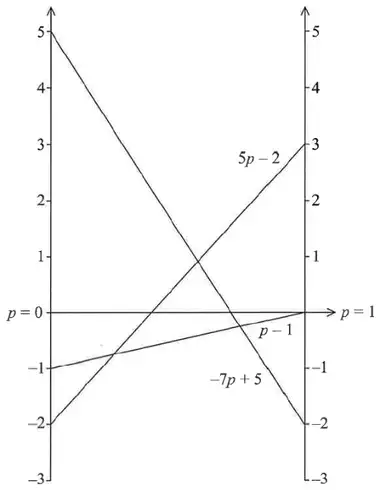
| (Let \(p\) = probability that Greg plays new row 1) If R plays 1: G’s expected winnings = \(3p - 2(1-p)\ (= 5p - 2)\) If R plays 2: G’s expected winnings = \(0p - 1(1-p)\ (= p - 1)\) If R plays 3: G’s expected winnings = \(-2p + 5(1-p)\ (= -7p + 5)\) | M1 A1 |
 | B2, 1ft, 0 |
| \(p - 1 = -7p + 5\) \(8p = 6\) \(p = \dfrac{3}{4}\) | DM1 A1 |
| G should play 1 with probability \(\frac{3}{4}\), 2 never and play 3 with probability \(\frac{1}{4}\) | A1ft |
| The value of the game to G is \(-\frac{1}{4}\) | A1 |
| (8) | |
| 16 marks |
Notes
e1M1: Setting up all three probability expressions (allow \(p - 1\)), implicit definition of ‘\(p\)’
e1A1: CAO (condone incorrect simplification)
e1B1ft: Attempt at three lines (correct slant direction and relative intersection with ‘axes’), accept \(p \gt 1\) or \(p \lt 0\) here but must go from ‘axis’ to ‘axis’ (give bod if close). Must be functions of \(p\)
e2B1: CAO \(0 \leqslant p \leqslant 1\), scaling correct and clear (expect to see 1 line = 1, although other scalings are acceptable eg 1 line = 2), condone lack of labels. Rulers used
e2DM1: Finding their correct optimal point, must have three lines and set up an equation to find \(0 \leqslant p \leqslant 1\). Dependent on first B mark in this part. Must have three intersection points. Solving all three simultaneous equations and stating incorrect \(p\) is M0
e2A1: CSO (must have scored all previous marks in (e))
e3A1ft: All three options listed must ft from their \(p\) \((0 \leqslant p \leqslant 1)\), check page 1 for G should never play 2. Dependent on both previous M marks in this part
e4A1: CAO \(\left(-\frac{1}{4}\right)\)
SC1: If column 1 is deleted in (d) candidates can earn a maximum in (e) ofM1 A0 B1 B0 M1 A0 A1 A1 (max. of 5) – the penultimate A mark is for G should play 1 never, play 2 and 3 with probability \(\frac{1}{2}\), final A mark is for the value of the game being \(-\frac{3}{2}\)
SC2: If column 3 is deleted in (d) candidates can earn a maximum in (e) ofM1 A0 B1 B0 M0 A0 A0 A0 (max. of 2)