
D2 June 2014 (R) Q3
3. A two-person zero-sum game is represented by the following pay-off matrix for player A.
| B plays 1 | B plays 2 | B plays 3 | |
|---|---|---|---|
| A plays 1 | –2 | 2 | –3 |
| A plays 2 | 1 | 1 | –1 |
| A plays 3 | 2 | –1 | 1 |
| Scheme | Marks | ||||||||||||
|---|---|---|---|---|---|---|---|---|---|---|---|---|---|
Column 3 dominates column 1, so delete column 1
| B1 | ||||||||||||
| Let B play 2 with probability \(p\) and 3 with probability \(1-p\) | B1 | ||||||||||||
| If A plays 1 B’s expected winnings are \(-\{2p - 3(1-p)\} = 3 - 5p\) If A plays 2 B’s expected winnings are \(-\{p - (1-p)\} = 1 - 2p\) If A plays 3 B’s expected winnings are \(-\{-p + (1-p)\} = 2p - 1\) | M1 A1 | ||||||||||||
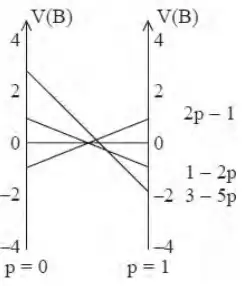 | M1 A1 | ||||||||||||
| \(2p - 1 = 1 - 2p\) | DM1 | ||||||||||||
| \(p = \dfrac{1}{2}\) | A1 | ||||||||||||
| B should play column 2 and column 3 each with probability \(\dfrac{1}{2}\) and never play column 1. | A1 | ||||||||||||
| (9) |
Notes
a1B1: CAO Col 3 dominates Col 1
a2B1: Defines \(p\) – allow those who define B play 2 with prob. \(p\) but no incorrect statements.
a1M1: Setting up three probability equations, implicit definition of \(p\).
a1A1: CAO (condone incorrect simplification).
a2M1: Three lines drawn, accept \(p \gt 1\) or \(p \lt 0\) here. Must be functions of \(p\).
a2A1: CAO \(0 \leqslant p \leqslant 1\), scale correct and clear (or 1 line = 1), condone lack of labels. Rulers used.
a3DM1: Must have drawn 3 lines. Finding their correct optimal point, must have three lines and set up an equation to find \(0 \leqslant p \leqslant 1\). Dependent on previous M mark. Must have three intersection points. If solving each pair of SE’s must clearly select the correct one or M0, but allow recovery if their choice is clear.
a3A1: CAO – dependent on all, but a2B1, being awarded in this part.
a4A1: CAO
| Scheme | Marks |
|---|---|
| V(B) = 0 | B1 |
| (1) | |
| 10 marks |
Notes
bDB1: CAO – dependent on all previous M marks in (a).