
D2 June 2005 Q7
7.
(a) Explain briefly what is meant by a zero-sum game. (1)
A two person zero-sum game is represented by the following pay-off matrix for player \(A\).
| I | II | III | |
|---|---|---|---|
| I | 5 | 2 | 3 |
| II | 3 | 5 | 4 |
(b) Verify that there is no stable solution to this game. (3)
(c) Find the best strategy for player \(A\) and the value of the game to her. (8)
(d) Formulate the game as a linear programming problem for player \(B\). Write the constraints as inequalities and define your variables clearly. (5)
| Scheme | Marks |
|---|---|
| A zero-sum game is one in which the sum of the gains for all players is zero. (o.e.) | B1 |
| (1) |
| Scheme | Marks | |||||||||||||||||||||||||
|---|---|---|---|---|---|---|---|---|---|---|---|---|---|---|---|---|---|---|---|---|---|---|---|---|---|---|
| M1 A1 | |||||||||||||||||||||||||
| Since \(3 \neq 4\) not stable | A1 | |||||||||||||||||||||||||
| (3) |
| Scheme | Marks |
|---|---|
| Let \(A\) play I with probability \(p\) Let \(A\) play II with probability \((1 - p)\) | |
| If \(B\) plays I \(A\)’s gains are \(5p + 3(1 - p) = 2p + 3\) If \(B\) plays II \(A\)’s gains are \(2p + 5(1 - p) = 5 - 3p\) If \(B\) plays III \(A\)’s gains are \(3p + 4(1 - p) = 4 - p\) | M1 A1 |
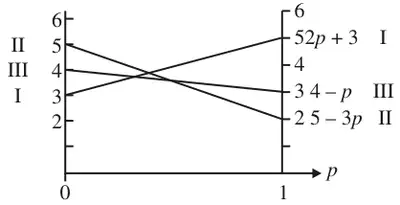 | A2, 1, 0 |
| Intersection of \(2p + 3\) and \(4 - p \Rightarrow p = \dfrac{1}{3}\) | M1 A1ft |
| \(\therefore A\) should play I \(\dfrac{1}{3}\) of time and II \(\dfrac{2}{3}\) of time; value (to \(A\)) \(= 3\dfrac{2}{3}\) | A1ft A1ft |
| (8) |
| Scheme | Marks |
|---|---|
| Let \(B\) play I with probability \(q_1\), II with probability \(q_2\) and III with probability \(q_3\) | B1 |
| e.g. Let \(x_1 = \dfrac{q_1}{v}\quad x_2 = \dfrac{q_2}{v}\quad x_3 = \dfrac{q_3}{v}\) | M1 |
| Maximise \(P = x_1 + x_2 + x_3\) | A1 |
| subject to \(5x_1 + 2x_2 + 3x_3 \leqslant 1\) \(3x_1 + 5x_2 + 4x_3 \leqslant 1\) \(x_1, x_2, x_3 \geqslant 0\) | A2, 1, 0 |
| (5) | |
| (17 marks) |
Notes
(Corrected from the printed mark scheme: the objective is printed as \(P = x_1 + x_2 = x_3\).)
Alt 1
| e.g. \(\begin{bmatrix}-5&-3\\-2&-5\\-3&-4\end{bmatrix} \to \begin{bmatrix}1&3\\4&1\\3&2\end{bmatrix}\) | |
| maximise \(P = V\) | |
| subject to \(v - q_1 - 4q_2 - 3q_3 \leqslant 0\) \(v - 3q_1 - q_2 - 2q_3 \leqslant 0\) \(q_1 + q_2 + q_3 \leqslant 1\) or \(= 1\) \(v, q_1, q_2, q_3 \geqslant 0\) |