
D1 June 2006 Q4
4.
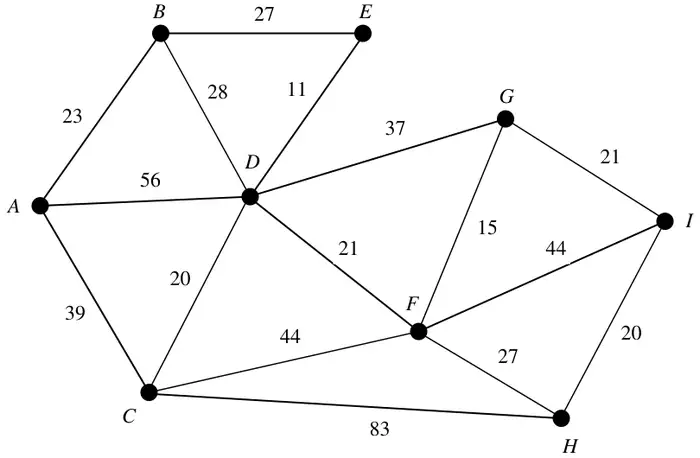
Figure 3 shows a network of cycle tracks. The number on each edge represents the length, in miles, of that track. Mary wishes to cycle from \(A\) to \(I\) as part of a cycling holiday. She wishes to minimise the distance she travels.
Mary wants to visit a theme park at \(E\).
| Scheme | Marks |
|---|---|
| A path is a (finite) sequence of edges, such that the end vertex of one edge is the start vertex of the next and in which no vertex appears more than once / no cycles | B2,1,0 |
| (2) |
Notes
B2 A good, complete description
B1 close – mostly there. ‘bod’ gets B1. ‘route’, ‘series’ may be ok.
| Scheme | Marks |
|---|---|
 | M1 A1 A1 A1ft |
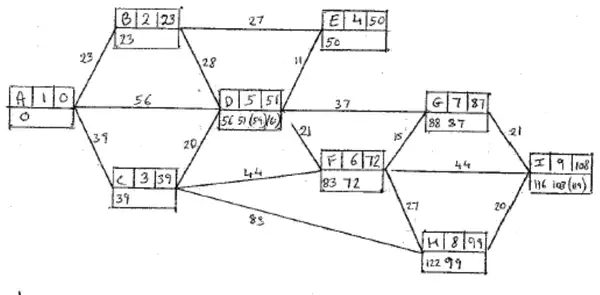
| shortest path: \(ABDFGI\), length: 108 miles | A1, A1ft |
| (6) |
Notes
M1 In \(D, F, G, H\) or \(I\) working value, larger replaced by smaller
A1 \(A, B, C, E\) correct labels in a rising sequence
A1 \(D, F\) correct labels ft
A1ft \(G, H, I\) correct labels ft (penalise order of labelling once only)
A1 Path c.a.o.
A1ft Length ft from \(I\); accept 108 if a correct path
| Scheme | Marks |
|---|---|
| e.g. \(108 - 21 = 87\ \ GI\) \(87 - 15 = 72\ \ FG\) \(72 - 21 = 51\ \ DF\) \(51 - 28 = 23\ \ BD\) \(23 - 23 = 0\ \ AB\) or – trace back from \(I\) – include arc \(XY\) if \(Y\) is already on the path and if the difference in final labels equals the length of arc | B2ft,1ft,0 |
| (2) |
Notes
B2ft complete version of one of the 2 given explanations
B1ft All there bar one step. ‘bod’ gets B1 – easy mark
| Scheme | Marks |
|---|---|
| \(ABEDFGI\) length 118 miles | M1 A1 |
| (2) | |
| (12 marks) |
Notes
M1 Route \(A\) to \(I\) including \(E\)
A1 cao