
D1 June 2018 Q4
4.
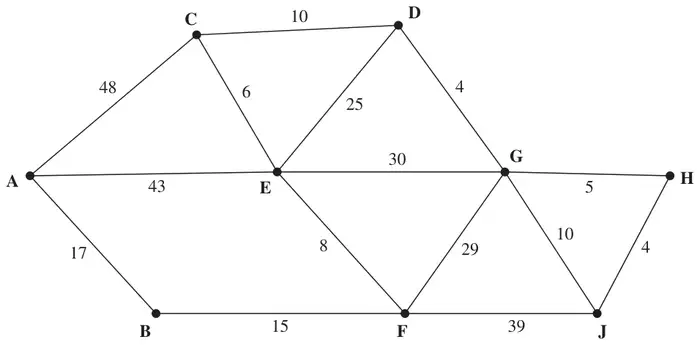
[The total weight of the network is 293]
Figure 2 models a network of roads. The number on each edge gives the time, in minutes, taken to travel along the corresponding road.
State the quickest route. (6)
The road represented by edge GJ is closed due to essential maintenance. Sahil needs to travel along all the other roads to check that they are in good repair. Sahil wishes to complete his route as quickly as possible and will start and finish at the same vertex.
Given that Sahil will start and finish at vertex C,
| Scheme | Marks |
|---|---|
| M1 A1 (ABFE) A1 (CDG) A1ft (HJ) | |
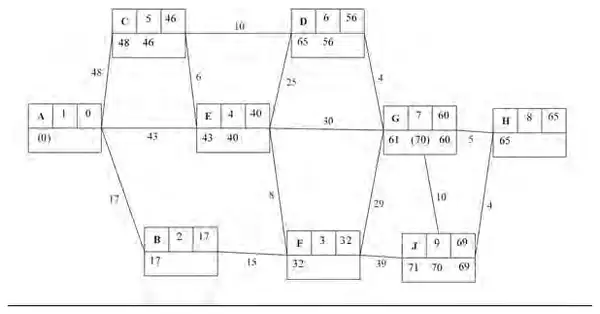
| Shortest time: 69 (minutes) | A1ft |
| Quickest route: ABFECDGHJ | A1 |
| (6) |
Notes
In (a) it is important that all values at each node are checked very carefully – the order of the working values must be correct for the corresponding A mark to be awarded e.g. at J the working values must be 71 70 69 in that order (so 70 71 69 is incorrect)It is also important that the order of labelling is checked carefully – some candidates start with a label of 0 at A (rather than 1) – which is fine. Also the order of labelling must be a strictly increasing sequence – so 1, 2, 3, 3, 4, … will be penalised once (see notes below) but 1, 2, 3, 5, 6, … is fine. Errors in the final values and working values are penalised before errors in the order of labellinga1M1: A larger value replaced by a smaller value at least once in the working values at either C or D or E or G or J
a1A1: All values in A, B, F and E correct and the working values in the correct order at E (including order of labelling). Condone lack of 0 in A’s working value
a2A1: All values C, D and G correct and the working values in the correct order. Penalise order of labelling only once per question (C, D and G must be labelled in that order and C must be labelled after A, B, F and E). Note that an additional working value of 70 at G betweeen the 61 and 60 is not an error so 61 70 60 is fine, however, any other number or the 70 not in this position is incorrect and scores A0
a3A1ft: All values in H and J correct on the follow through and the working values in the correct order. Penalise order of labelling only once per question. To follow through H check that the working value at H follows from the candidate’s final values from node G and that the final value, and order of labelling, follows through correctly. Repeat this process for J (which will have working values from F, G and H with the order of these values determined by the candidates order of labelling of F, G and H)
a4A1ft: Their final value at J only (condone lack of units)
a5A1: CAO - correct route (from either A to J or J to A)
| Scheme | Marks |
|---|---|
| A(BFE)C + D(C)E = 46+ 16 = 62 | M1 A1 |
| A(BFEC)D + CE = 56 + 6 = 62 | A1 |
| A(BF)E + CD = 40 + 10 = 50* | A1 |
| Repeat edges: AB, BF, EF and CD | A1 |
| Duration = 293 – 10 + 50 = 333 (minutes) | A1 |
| (6) |
Notes
b1M1: Three distinct pairings of A, C, D and E
b1A1: Any row correct including pairing and total
b2A1: Any two rows correct including pairings and totals
b3A1: All three rows correct including pairings and totals
b4A1: CAO correct edges clearly stated (and not just in their working) as AB, BF, EF, CD. Do not accept AE, ABFE or AE via B and F
b5A1: CAO (333)
| Scheme | Marks |
|---|---|
| Vertex E: 3 Vertex F: 3 | B1 B1 |
| (2) | |
| (14 marks) |
Notes
c1B1: CAO (vertex E)
c2B1: CAO (vertex F)
In (c) if answer lines not used then:
| 3, 3 | B1 B1 |
| 3 + 3 = 6 | B1 B1 |
| 3, \(x\) where \(x \ne 3\) | B1 B0 |
| \(x\), 3 where \(x \ne 3\) | B0 B1 |
| 3 | B1 B1 |
| 6 | B0 B0 |
If after (b) a 3 appears only and it is not labelled as (c) then award no marks