
D1 June 2016 Q8
8. Charlie needs to buy storage containers.
There are two different types of storage container available, standard and deluxe.
Standard containers cost £20 and deluxe containers cost £65. Let \(x\) be the number of standard containers and \(y\) be the number of deluxe containers.
The maximum budget available is £520
Three further constraints are:
\[\begin{aligned} x &\geqslant 2\\ -x + 24y &\geqslant 24\\ 7x + 8y &\leqslant 112 \end{aligned}\]The capacity of a deluxe container is 50% greater than the capacity of a standard container. Charlie wishes to maximise the total capacity.
| Scheme | Marks |
|---|---|
| \(20x + 65y \leqslant 520\) or \(4x + 13y \leqslant 104\) (oe) | B1 |
| (1) |
Notes
a1B1: CAO – accept any exact equivalent inequality (isw if simplified incorrectly)
| Scheme | Marks |
|---|---|
| B1 | |
| B1 | |
| B1 | |
| DB1 (R) | |
| (4) |
Notes
In (b):
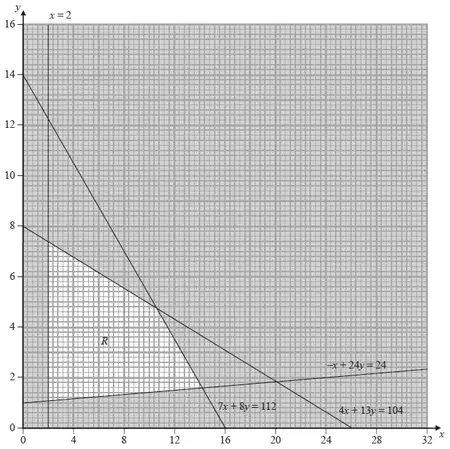
\(7x + 8y = 112\) must pass within one small square of its intersection with the axes – (0, 14) and (16, 0)
\(20x + 65y = 520\) must pass within one small square of its intersection with the axes – (0, 8) and (26, 0)
\(-x + 24y = 24\) must be sufficiently long to define the feasible region and pass within one small square of (0, 1) and (24, 2) if extended
\(x = 2\) must pass within one small square of (2, 0) and (2, 8)
b1B1: Any two lines correctly drawn
b2B1: Any three lines correctly drawn
b3B1: All four lines correctly drawn
b4DB1: Region, R, correctly labelled – not just implied by shading – dependent on scoring the first three marks in this part
| Scheme | Marks |
|---|---|
| e.g. \((P =)\ 2x + 3y\) | B1 |
| (1) |
Notes
c1B1: CAO - \(k(2x + 3y)\) where \(k \in \mathbb{R}\) – condone equal to \(P\) or equal to a constant
| Scheme | Marks |
|---|---|
| Drawing an objective line accept reciprocal gradient | M1 |
| Correct objective line minimum length equivalent to (0, 1) to (1.5, 0) | A1 |
| V correctly labelled | A1 |
| (3) |
Notes
d1M1: Drawing either the correct objective line or their objective line (based on their answer to (c)) or the reciprocal of the correct objective line or the reciprocal of their objective line – if their line is shorter than the length equivalent to that of the line from (0, 1) to (1.5, 0) then M0. Line must be correct to within one small square if extended from axis to axis
d1A1: Drawing the correct objective line – same condition that the line must be correct to within one small square if extended from axis to axis
d2A1: Correct V labelled clearly on their graph – please note that this mark is dependent on scoring at least B1B1B1B0 in (b) and the two previous marks in this part – by clearly labelled the vertex should either be labelled ‘V’ or circled or clearly distinguishable from the other three (but A0 if not clear e.g. other vertices circled too)
| Scheme | Marks |
|---|---|
| \(\text{V}\left(\dfrac{624}{59},\ \dfrac{280}{59}\right)\) | M1 A1 |
| (2) |
Notes
e1M1: Simultaneous equations being used to find V. Must have scored at least B1B1B0B0 in (b) and candidates must have labelled one of their vertices as V (oe – see above). Must be solving either the pair of simultaneous equations \(20x + 65y = 520\) and \(7x + 8y = 112\) or \(7x + 8y = 112\) and \(-x + 24y = 24\). Must be a correct method to solve simultaneous equations and must arrive at \(x = \ldots\) and \(y = \ldots\) but allow slips/errors. This mark can also be awarded for the correct exact coordinates stated with no working provided B1B1B0B0 in (b) and a vertex labelled as V
e1A1: Correct exact coordinates of the correct V derived with working (not just stated) as either \(\left(\dfrac{624}{59},\ \dfrac{280}{59}\right)\) or \(\left(10\dfrac{34}{59},\ 4\dfrac{44}{59}\right)\) or stated just in terms of \(x\) and \(y\). Note that this mark is dependent on B1B1B1B0 scored in (b) and all three marks in (d). ISW if correct exact values seen followed by decimal approximations
| Scheme | Marks |
|---|---|
| Testing integer solutions around V, \(x = 11\) and \(y = 4\) is optimal integer solution, so they should buy 11 standard containers and 4 deluxe containers | M1 A1 |
| Cost is (£) 480 | B1 |
| (3) | |
| (14 marks) |
Notes
f1M1: Testing any two of (11, 4) or (9, 5) or (10, 5) or (10, 4) or (11, 5) in a correct objective function or the correct pair of inequalities. Note candidates may reject a point after testing in only one correct inequality which is acceptable – this mark is not dependent on any previous mark
f1A1: CSO (all previous 12 marks must have been awarded) – must have tested (11, 4) in the correct objective function or correct pair of inequalities – accept \(x = 11\) and \(y = 4\) or stated as a pair of coordinates
f1B1: CAO – this mark is not dependent on any previous mark and condone lack of units