
D1 June 2017 Q5
5.
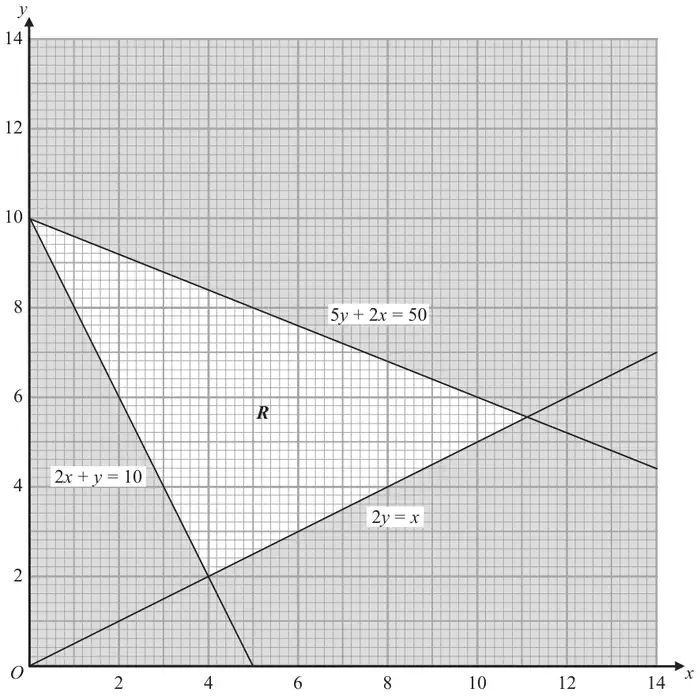
Figure 5 shows the constraints of a linear programming problem in \(x\) and \(y\), where \(R\) is the feasible region.
The objective is to maximise \(P\), where \(P = 2x + 3y\)
The objective is changed to maximise \(Q\), where \(Q = 2x + \lambda y\)
Given that \(\lambda\) is a constant and V is still the only optimal vertex of the feasible region,
| Scheme | Marks |
|---|---|
| \(2y \geqslant x\) \(5y + 2x \leqslant 50\) \(2x + y \geqslant 10\) | B2, 1, 0 |
| (2) |
Notes
a1B1: Any two correct (accept strict inequalities) – accept equivalent inequalities
a2B1: CAO (accept equivalent inequalities)
| Scheme | Marks |
|---|---|
| (4,2), (0,10) | B1 |
| \(\left(\dfrac{100}{9},\ \dfrac{50}{9}\right)\) or \(\left(11\dfrac{1}{9},\ 5\dfrac{5}{9}\right)\) | M1 A1 |
| (3) |
Notes
b1B1: CAO for both integer coordinates – accept \(x = 4,\ y = 2\), etc.
b1M1: Using simultaneous equations to find the non-integer vertex – must get to \(x = \ldots\) and \(y = \ldots\) Must be a correct method to solve simultaneous equations but allow slips/errors. If no working present then this mark can be awarded for an awrt (11.1, 5.56) or (11.1, 5.55)
b1A1: CAO – must be exact (condone correct recurring decimal notation). If correct answer seen with no working then award M1 A1 in this part. ISW if correct exact answer seen which is then given in non-exact form
| Scheme | Marks |
|---|---|
| \((0,10) \to P = 30\) \((4,2) \to P = 14\) \(\left(\dfrac{100}{9},\ \dfrac{50}{9}\right) \to P = \dfrac{350}{9}\) or \(38\dfrac{8}{9}\) so optimal vertex is \(\left(\dfrac{100}{9},\ \dfrac{50}{9}\right)\) | M1 A1 |
| (2) |
Notes
c1M1: Testing all three of their vertices in the correct objective function
c1A1: Correct three values for \(P\) (accept awrt 38.9 for 350/9) and correct optimal vertex either stated or clearly indicated (allow awrt (11.1, 5.56) or (11.1, 5.55))
| Scheme | Marks |
|---|---|
| \(Q = 2x + \lambda y\) | |
| \(2\left(\dfrac{100}{9}\right) + \lambda\left(\dfrac{50}{9}\right) \gt 2(0) + \lambda(10)\) or objective line method (see Way 2) | M1 |
| \(\Rightarrow \lambda \lt 5\) | A1 |
| \(2\left(\dfrac{100}{9}\right) + \lambda\left(\dfrac{50}{9}\right) \gt 2(4) + \lambda(2)\) or objective line method (see Way 2) | M1 |
| \(\Rightarrow \lambda \gt -4\) | A1 |
| \((-4 \lt \lambda \lt 5)\) | |
| (4) | |
| (11 marks) |
Notes
d1M1: WAY 1 – point testing: Their attempt at \(\left(\dfrac{100}{9},\ \dfrac{50}{9}\right)\) evaluated in \(Q\) compared to (0, 10) evaluated in \(Q\) - allow any inequality sign or equals
d1A1: \(\lambda \lt 5\) (CAO so allow equals used throughout and then the correct inequality at the end but A0 if incorrect inequality seen in working or if non-exact values used in working)
d2M1: Their attempt at \(\left(\dfrac{100}{9},\ \dfrac{50}{9}\right)\) evaluated in \(Q\) compared to (4, 2) evaluated in \(Q\) – allow any inequality sign or equals
d2A1: \(\lambda \gt -4\) (CAO - see d1A1). Do not award this mark if candidates give both correct answers and then give an answer of \(0 \lt \lambda \lt 4\) or if any additional answers seen
SC for Way 1: If optimal vertex in (c) is either (4, 2) or (0, 10) then the M mark not awarded in (d) can be awarded for evaluating and comparing (4, 2) with (0, 10) in \(Q\). Therefore an incorrect optimal vertex in (c) can earn at most M1A0M1A0 in (d)NOTE that in WAY 2 the 2nd A mark is dependent on the correct three vertices of the feasible regiond1M1: WAY 2 – objective line: \(-\dfrac{2}{\lambda}\) compared to either \(-\dfrac{2}{5}\) or \(\dfrac{1}{2}\) or \(-2\) (oe e.g. \(\dfrac{2}{\lambda}\) with \(\dfrac{2}{5}\), \(\dfrac{\lambda}{2}\) with \(\dfrac{5}{2}\), etc.) so correctly comparing the gradient of the new objective line with any one of the three line segments that define \(R\) – accept any inequality or equals
d1A1: \(\lambda \lt 5\) or \(\lambda \gt -4\) (CAO so allow equals used throughout and then the correct inequality at the end but A0 if incorrect inequality seen in working)
d2M1: \(-\dfrac{2}{\lambda}\) compared to both \(-\dfrac{2}{5}\) and \(\dfrac{1}{2}\) (oe) – so correctly comparing the gradient of the new objective with the correct two line segments that give the correct optimal vertex - accept any inequality or equals
d2A1: \(\lambda \lt 5\) and \(\lambda \gt -4\) only (CAO - see d1A1) – note that this mark is dependent on all correct three vertices that define the feasible region and must come from correct comparisons with \(-\dfrac{2}{5}\) and \(\dfrac{1}{2}\). Do not award this mark if candidates give the correct answer and then give an answer of \(0 \lt \lambda \lt 4\) or if any additional answers seen
Note that the correct answers in Way 2 must come from \(-\dfrac{2}{\lambda} \lt -\dfrac{2}{5}\) and \(-\dfrac{2}{\lambda} \gt \dfrac{1}{2}\)
Correct answers with no workingAward d1M1 and d1A1 (first two marks) for one correct answer then d2M1 and d2A1 (full marks) for both correct answers only (so no additional answers) – if any of the three vertices of the feasible region are incorrect then award the first three marks for both correct answers only