
D1 June 2014 (R) Q4
4.
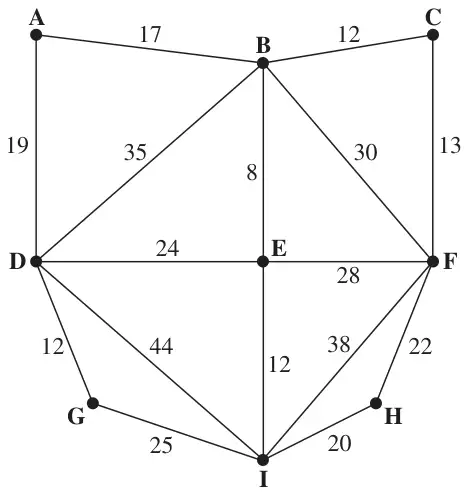
[The total weight of the network is 359 cm]
Figure 4 represents the network of sensor wires used in a medical scanner. The number on each arc represents the length, in cm, of that section of wire.
After production, each scanner is tested.
A machine will be programmed to inspect each section of wire.
It will travel along each arc of the network at least once, starting and finishing at A. Its route must be of minimum length.
The machine will inspect 15 cm of wire per second.
It is now possible for the machine to start at one vertex and finish at a different vertex. An inspection route of minimum length is still required.
Due to constraints at the factory, only B or D can be chosen as the starting point and there will also be a 2 second pause between tests.
| Scheme | Marks |
|---|---|
| B(E)D + FI = 32 + 38 = 70 | M1 A1 |
| B(C)F + D(E)I = 25 + 36 = 61* | A1 |
| B(E)I + D(E)F = 20 + 52 = 72 | A1 |
| Length = 359 + 61 = 420 | A1ft |
| (5) |
Notes
a1M1: Three pairings of the correct four odd nodes.
a1A1: One row correct including pairing and total.
a2A1: Two rows correct including pairing and total.
a3A1: Three rows correct including pairing and total.
a4A1ft: 420 or 359 + their least.
| Scheme | Marks |
|---|---|
| Time taken \(= \dfrac{420}{15} \times 120 = 3360\) (seconds) | M1 A1 |
| (2) |
Notes
b1M1: Their length \(\div 15 \times 120\) – from at least two totals seen in (a).
b1A1: CAO
| Scheme | Marks |
|---|---|
| e.g. If we start at an odd vertex we will finish at another odd vertex. This removes the need to repeat the route between them. So we just have to consider one repeated route rather than two. | B2,1,0 |
| (2) |
Notes
c1B1: One of (i) idea of finishing at an odd vertex (ii) only having to repeat one route rather than two.
c2B1: Correct complete argument – including both (i) and (ii) from c1B1.
| Scheme | Marks |
|---|---|
| Choose to repeat the shortest route BI (20) | B1 |
| Therefore start at D (and finish at F) | B1 |
| New length = 359 + 20 = 379 | B1 |
| Time taken \(= \dfrac{379}{15} \times 120 + 2 \times 119 = 3270\) (seconds) | B1 |
| (4) | |
| (13 marks) |
Notes
d1B1: Identifies BI as the shortest route.
d2B1: start at D – dependent on identifying BI (20) as the repeat.
d3B1: CAO
d4B1: CAO