
D1 January 2012 Q7
7.
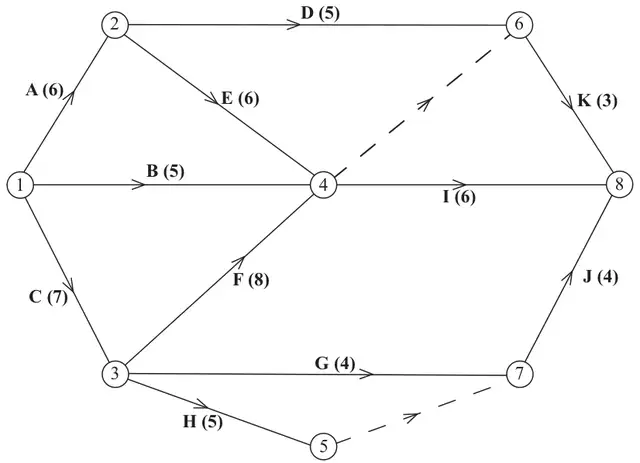
A project is modelled by the activity network shown in Figure 7. The activities are represented by the arcs. The number in brackets on each arc gives the time required, in hours, to complete the activity. The numbers in circles are the event numbers. Each activity requires one worker.
| Scheme | Marks |
|---|---|
| (i) I depends on B, E and F only, K depends on B, E, F and D | B1 DB1 |
| (ii) This is so that G and H will not share the same start and end events. So that G and H can be uniquely described in terms of their end events. | B1 |
| (3) |
Notes
ai1B1: K, I, D and at least one of B, E, F referred to. Correct statement but maybe incomplete give bod here.
ai2DB1: Clear correct statement. No bod.
aii3B1: correct statement referring to either events or activities. (‘unique’ alone not enough)
| Scheme | Marks |
|---|---|
 | M1 A1 M1 A1 |
| (4) |
Notes
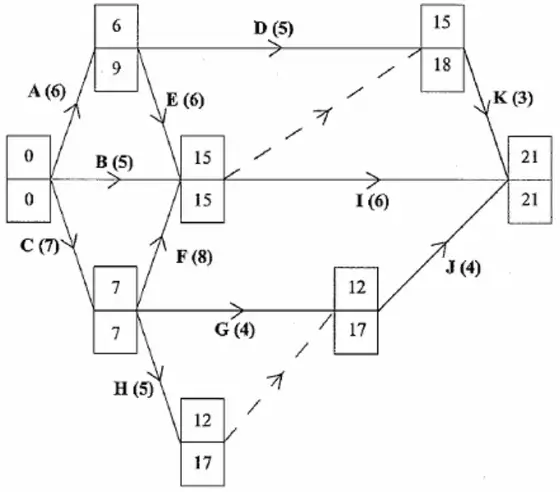
b1M1: All top boxes complete, values generally increasing left to right, condone one rogue
b1A1: CAO
b2M1: All bottom boxes complete, values generally decreasing R to L, condone one rogue
b2A1: CAO
| Scheme | Marks |
|---|---|
| Total float on D = 18 – 5 – 6 = 7 Total float on G = 17 – 4 – 7 = 6 | M1 A1ft B1 |
| (3) |
Notes
c1M1: Correct calculation seen once, all three numbers correct (ft).
c1A1ft: one float ( \(\geqslant\) 0) correct.
c1B1: Both floats correct (independent of working)
| Scheme | Marks |
|---|---|
| Lower bound = \(\dfrac{59}{21} = 3\) workers | M1 A1cso |
| (2) |
Notes
d1M1: Attempt to calculate a lower bound. [51-67 / their finish time]. Accept awrt 2.81
d1A1: CSO.
| Scheme | Marks |
|---|---|
 | M1 A1 M1 A1 |
| (4) | |
| (16 marks) |
Notes
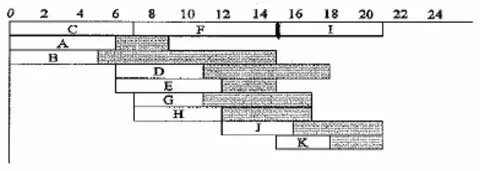
e1M1: At least 7 activities including at least 4 floats. Do not accept scheduling diagram.
e1A1: Critical activities dealt with correctly
e2M1: All 11 activities including at least 8 floats
e2A1: Non-critical activities dealt with correctly