
FP2 June 2011 Q6
6.
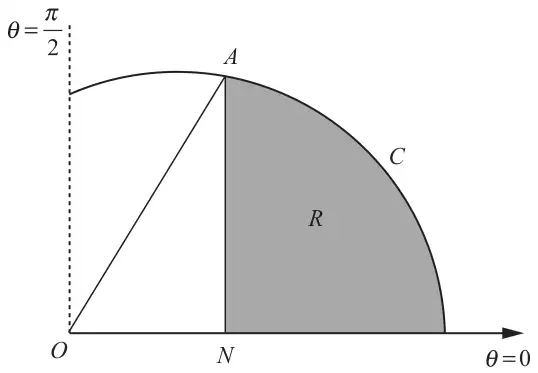
The curve \(C\) shown in Figure 1 has polar equation \[r = 2 + \cos\theta, \quad 0 \leqslant \theta \leqslant \frac{\pi}{2}\]
At the point \(A\) on \(C\), the value of \(r\) is \(\dfrac{5}{2}\).
The point \(N\) lies on the initial line and \(AN\) is perpendicular to the initial line.
The finite region \(R\), shown shaded in Figure 1, is bounded by the curve \(C\), the initial line and the line \(AN\).
Find the exact area of the shaded region \(R\). (9)
| Scheme | Marks |
|---|---|
| \(2 + \cos\theta = \dfrac{5}{2} \Rightarrow \theta = \dfrac{\pi}{3}\) | B1 |
| \(\dfrac{1}{2}\displaystyle\int (2 + \cos\theta)^2\,\mathrm{d}\theta = \frac{1}{2}\int (4 + 4\cos\theta + \cos^2\theta)\,\mathrm{d}\theta\) | M1 |
| \(= \dfrac{1}{2}\left[4\theta + 4\sin\theta + \dfrac{\sin 2\theta}{4} + \dfrac{\theta}{2}\right]\) | M1 A1 |
| Substituting limits \(\left(\dfrac{1}{2}\left[\dfrac{9\pi}{6} + 4\dfrac{\sqrt{3}}{2} + \dfrac{\sqrt{3}}{8}\right] = \dfrac{1}{2}\left(\dfrac{3\pi}{2} + \dfrac{17\sqrt{3}}{8}\right)\right)\) | M1 |
| Area of triangle \(= \dfrac{1}{2}(r\cos\theta)(r\sin\theta) = \dfrac{1}{2} \times \dfrac{25}{4} \times \dfrac{1}{2} \times \dfrac{\sqrt{3}}{2}\ \left(= \dfrac{25\sqrt{3}}{32}\right)\) | M1 A1 |
| Area of \(R = \dfrac{3\pi}{4} + \dfrac{17\sqrt{3}}{16} - \dfrac{25\sqrt{3}}{32} = \dfrac{3\pi}{4} + \dfrac{9\sqrt{3}}{32}\) | M1 A1 |
| (9 marks) |
Notes
1st M1 for use of \(\dfrac{1}{2}\displaystyle\int r^2\,\mathrm{d}\theta\) and correct attempt to expand
2nd M1 for use of double angle formula - \(\sin 2\theta\) required in square brackets
3rd M1 for substituting their limits
4th M1 for use of \(\dfrac{1}{2}\) base x height
5th M1 area of sector – area of triangle
Please note there are no follow through marks on accuracy.