
FP1 June 2012 Q5
5.
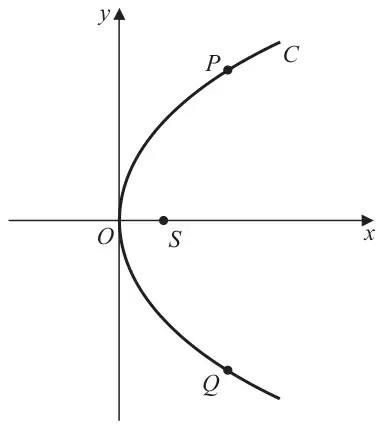
Figure 1 shows a sketch of the parabola \(C\) with equation \(y^2 = 8x\).
The point \(P\) lies on \(C\), where \(y > 0\), and the point \(Q\) lies on \(C\), where \(y < 0\)
The line segment \(PQ\) is parallel to the \(y\)-axis.
Given that the distance \(PQ\) is 12,
(a) write down the \(y\)-coordinate of \(P\), (1)
(b) find the \(x\)-coordinate of \(P\). (2)
Figure 1 shows the point \(S\) which is the focus of \(C\).
The line \(l\) passes through the point \(P\) and the point \(S\).
(c) Find an equation for \(l\) in the form \(ax + by + c = 0\), where \(a\), \(b\) and \(c\) are integers. (4)
| Scheme | Marks |
|---|---|
| \(C: y^2 = 8x \Rightarrow a = \tfrac{8}{4} = 2\) | |
| \(PQ = 12 \Rightarrow\) By symmetry \(y_P = \tfrac{12}{2} = \underline{6}\) \(y = \underline{6}\) | B1 |
| [1] |
| Scheme | Marks |
|---|---|
| \(y^2 = 8x \Rightarrow 6^2 = 8x\) Substitutes their \(y\)-coordinate into \(y^2 = 8x\). | M1 |
| \(\Rightarrow x = \tfrac{36}{8} = \tfrac{9}{2}\) (So \(P\) has coordinates \(\left(\tfrac{9}{2},\ 6\right)\)) \(\Rightarrow x = \underline{\tfrac{36}{8}}\) or \(\underline{\tfrac{9}{2}}\) | A1 oe |
| [2] |
| Scheme | Marks |
|---|---|
| Focus \(S(2,\ 0)\) Focus has coordinates \((2,\ 0)\). Seen or implied. Can score anywhere. | B1 |
| Gradient \(PS = \dfrac{6 - 0}{\frac{9}{2} - 2}\ \left\{= \dfrac{6}{\left(\frac{5}{2}\right)} = \dfrac{12}{5}\right\}\) Correct method for finding the gradient of the line segment \(PS\). If no gradient formula is quoted and the gradient is incorrect, score M0 but allow this mark if there is a clear use of \(\dfrac{y_2 - y_1}{x_2 - x_1}\) even if their coordinates are ‘confused’. | M1 |
| Either \(y - 0 = \tfrac{12}{5}(x - 2)\) or \(y - 6 = \tfrac{12}{5}\left(x - \tfrac{9}{2}\right)\); or \(y = \tfrac{12}{5}x + c\) and \(0 = \tfrac{12}{5}(2) + c \Rightarrow c = -\tfrac{24}{5}\); \(y - y_1 = m(x - x_1)\) with ‘their \(PS\) gradient’ and their \((x_1,\ y_1)\) Their PS gradient must have come from using P and S (not calculus) and they must use their P or S as \((x_1, y_1)\). or uses \(y = mx + c\) with ‘their gradient’ in an attempt to find \(c\). Their PS gradient must have come from using P and S (not calculus) and they must use their P or S as \((x_1, y_1)\). | M1 |
| \(l\): \(\underline{12x - 5y - 24 = 0}\) \(\underline{12x - 5y - 24 = 0}\) | A1 |
| [4] | |
| 7 marks |
Notes
Allow any equivalent form e.g. \(k(12x - 5y - 24) = 0\) where \(k\) is an integer