
FP1 June 2015 Q4
4. \[z_1 = 3\mathrm{i} \text{ and } z_2 = \frac{6}{1 + \mathrm{i}\sqrt{3}}\]
| Scheme | Marks |
|---|---|
| \(z_2 = \dfrac{6(1 - \mathrm{i}\sqrt{3})}{(1 + \mathrm{i}\sqrt{3})(1 - \mathrm{i}\sqrt{3})} = \dfrac{6(1 - \mathrm{i}\sqrt{3})}{4}\) | M1 |
| \(z_2 = \dfrac{6(1 - \mathrm{i}\sqrt{3})}{4}\ \left(= \dfrac{3}{2} - \mathrm{i}\dfrac{3}{2}\sqrt{3}\right)\) | A1 |
| (2) |
Notes
M1: Multiplies numerator and denominator by \(1 - \mathrm{i}\sqrt{3}\)
A1: any correct equivalent with real denominator.
| Scheme | Marks |
|---|---|
| \(|z_2| = \sqrt{\left(\dfrac{3}{2}\right)^2 + \left(\dfrac{3\sqrt{3}}{2}\right)^2} = \sqrt{\dfrac{9}{4} + \dfrac{27}{4}}\) | M1 |
| The modulus of \(z_2\) is 3 | A1 |
| \(\tan\theta = (\pm)\sqrt{3}\) and attempts to find \(\theta\) | M1 |
| and the argument is \(-\dfrac{\pi}{3}\) | A1 |
| (4) |
Notes
M1: Uses correct method for modulus for their \(z_2\) in part (a)
A1: for 3 only
M1: Uses tan or inverse tan
A1: \(-\dfrac{\pi}{3}\) accept \(\dfrac{5\pi}{3}\)
NB Answers only then award 4/4 but arg must be in terms of \(\pi\)
| Scheme | Marks |
|---|---|
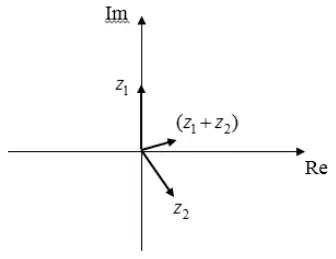 | M1 A1 |
| (2) | |
| (8 marks) |
Notes
M1: Either \(z_1\) on imaginary axis and labelled with \(z_1\) or 3i or (0,3) or axis labelled 3;
or their \(z_2\) in the correct quadrant labelled \(z_2\) or \(\dfrac{3}{2} - \mathrm{i}\dfrac{3}{2}\sqrt{3}\) or \(\left(\dfrac{3}{2}, -\dfrac{3}{2}\sqrt{3}\right)\) or axes labelled
or their \(a + b\mathrm{i}\) or their \((a, b)\) or axes labelled.
Axes need not be labelled Re and Im.
A1: All 3 correct ie \(z_1\) on positive imaginary axis, \(z_2\) in 4th quadrant and \(z_1 + z_2\) in the first quadrant.
Accept points or lines. Arrows not required.