
M3 January 2011 Q7
7.
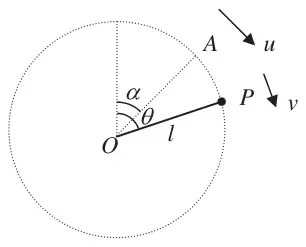
A particle \(P\) of mass \(m\) is attached to one end of a light rod of length \(l\). The other end of the rod is attached to a fixed point \(O\). The rod can turn freely in a vertical plane about \(O\). The particle is projected with speed \(u\) from a point \(A\), where \(OA\) makes an angle \(\alpha\) with the upward vertical through \(O\) and \(0 < \alpha < \tfrac{\pi}{2}\). When \(OP\) makes an angle \(\theta\) with the upward vertical through \(O\) the speed of \(P\) is \(v\) as shown in Figure 5.
(a) Show that \(v^2 = u^2 + 2gl(\cos\alpha - \cos\theta)\). (4)
It is given that \(\cos\alpha = \tfrac{3}{5}\) and that \(P\) moves in a complete vertical circle.
(b) Show that \(u > 2\sqrt{\left(\dfrac{gl}{5}\right)}\). (4)
As the rod rotates the least tension in the rod is \(T\) and the greatest tension is \(5T\).
(c) Show that \(u^2 = \dfrac{33}{10}gl\). (9)
| Scheme | Marks |
|---|---|
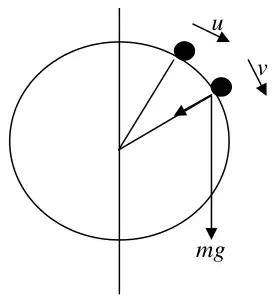
| \(mgl(\cos\alpha - \cos\theta) = \dfrac{1}{2}mv^2 - \dfrac{1}{2}mu^2\) | M1A1=A1 |
| \(v^2 = u^2 + 2gl(\cos\alpha - \cos\theta)\) * | A1 |
| (4) |
| Scheme | Marks |
|---|---|
| \(\cos\alpha = \dfrac{3}{5} \qquad v^2 = 2gl\left(\dfrac{3}{5} - \cos\theta\right) + u^2\) At top \(\theta = 360^\circ \qquad v^2 = 2gl\left(\dfrac{3}{5} - 1\right) + u^2\) | M1A1 |
| \(v^2 > 0 \qquad -2gl \times \dfrac{2}{5} + u^2 > 0\) \(u^2 > \dfrac{4gl}{5}\) | M1 |
| \(u > 2\sqrt{\dfrac{gl}{5}}\) * | A1 |
| (4) |
| Scheme | Marks |
|---|---|
| Equation of motion along radius at lowest point: \(T_1 - mg = \dfrac{mv^2}{l}\) | M1A1 |
| \(\theta = 180 \qquad v^2 = 2gl\left(\dfrac{3}{5} + 1\right) + u^2\) \(v^2 = \dfrac{16gl}{5} + u^2\) \(T_1 = \dfrac{m}{l}\left(\dfrac{16gl}{5} + u^2\right) + mg\) | M1 |
| \(= \dfrac{21mg}{5} + \dfrac{mu^2}{l}\) | A1 |
| At highest point: \(T_2 + mg = \dfrac{mv^2}{l}\) | M1 |
| \(\theta = 360 \qquad T_2 = 2mg\left(-\dfrac{2}{5}\right) + \dfrac{mu^2}{l} - mg\) | M1 |
| \(T_2 = \dfrac{mu^2}{l} - \dfrac{9mg}{5}\) \(T_1 = 5T_2\) | A1 |
| \(\dfrac{21mg}{5} + \dfrac{mu^2}{l} = 5\left(\dfrac{mu^2}{l} - \dfrac{9mg}{5}\right)\) \(\dfrac{66mg}{5} = \dfrac{4mu^2}{l}\) | M1 |
| \(u^2 = \dfrac{33gl}{10}\) * | A1 |
| (9) | |
| (17 marks) |