
M3 January 2010 Q3
3.
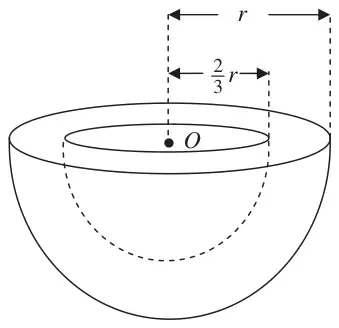
A bowl \(B\) consists of a uniform solid hemisphere, of radius \(r\) and centre \(O\), from which is removed a solid hemisphere, of radius \(\dfrac{2}{3}r\) and centre \(O\), as shown in Figure 1.
(a) Show that the distance of the centre of mass of \(B\) from \(O\) is \(\dfrac{65}{152}r\). (5)
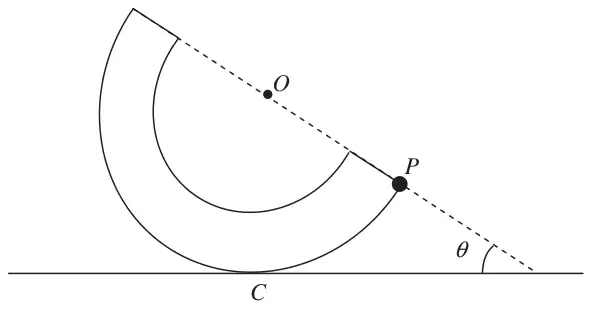
The bowl \(B\) has mass \(M\). A particle of mass \(kM\) is attached to a point \(P\) on the outer rim of \(B\). The system is placed with a point \(C\) on its outer curved surface in contact with a horizontal plane. The system is in equilibrium with \(P\), \(O\) and \(C\) in the same vertical plane. The line \(OP\) makes an angle \(\theta\) with the horizontal as shown in Figure 2. Given that
\(\tan\theta = \dfrac{4}{5}\),
(b) find the exact value of \(k\). (5)
| Scheme | Marks |
|---|---|
| \(\begin{array}{lccc} & s & B & S\\ \text{Mass ratios} & 8 & 19 & 27\end{array}\) anything in correct ratio | B1 |
| \(\begin{array}{lccc}\bar{x} & \dfrac{3}{8} \times \dfrac{2}{3}r & \bar{x} & \dfrac{3}{8}r\end{array}\) | B1 |
| \(8 \times \dfrac{1}{4}r + 19\bar{x} = 27 \times \dfrac{3}{8}r\) | M1 A1ft |
| \(\bar{x} = \dfrac{65}{152}r\) * | A1 |
| (5) |
| Scheme | Marks |
|---|---|
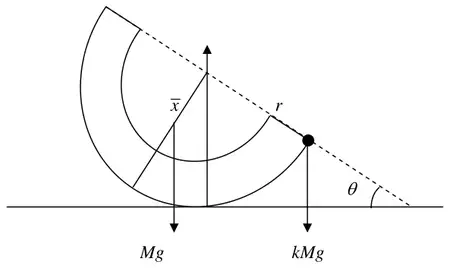
| \(Mg \times \bar{x}\sin\theta = kMg \times r\cos\theta\) | M1 A1=A1 |
| leading to \(\quad k = \dfrac{13}{38}\) | M1 A1 |
| (5) | |
| (10 marks) |