
M1 June 2016 Q6
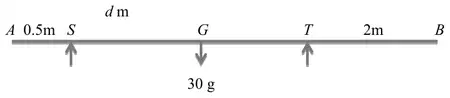
6. A non-uniform plank \(AB\) has length 6 m and mass 30 kg. The plank rests in equilibrium in a horizontal position on supports at the points \(S\) and \(T\) of the plank where \(AS = 0.5\) m and \(TB = 2\) m.
When a block of mass \(M\) kg is placed on the plank at \(A\), the plank remains horizontal and in equilibrium and the plank is on the point of tilting about \(S\).
When the block is moved to \(B\), the plank remains horizontal and in equilibrium and the plank is on the point of tilting about \(T\).
The distance of the centre of mass of the plank from \(A\) is \(d\) metres. The block is modelled as a particle and the plank is modelled as a non-uniform rod. Find
| Scheme | Marks |
|---|---|
| \(M(S)\): \(\ Mg \times 0.5 = 30g(d - 0.5)\) | M1 A1 |
| \(M(T)\): \(\ Mg \times 2 = 30g(4 - d)\) | M1 A1 |
| dividing: \(\ 4 = \dfrac{(4 - d)}{(d - 0.5)} \Rightarrow\) (i) \(d = 1.2\) | DM1 A1 |
| \(\Rightarrow\) (ii) \(M = 42\) | A1 |
| (7 marks) |
Notes
N.B. They may use a different variable, other than \(d\), in their moments equations
e.g. say they use \(x = SG\) consistently, they can score all the marks for their two equations and if they eliminate \(x\) correctly, DM1 A1 (for \(M\)), and, if they found \(x\) correctly, then added 0.5 to obtain \(d\), the other A1 also.
First M1 for moments about \(S\) (need correct no. of terms, so if they don’t realise that the reaction at \(T\) is zero it’s M0) to give an equation in \(d\) and \(M\) only.
First A1 for a correct first equation in \(d\) and \(M\) only. (A1 for both g’s or no g’s but A0 if one g is missing )
N.B. They may use 2 equations and eliminate to obtain their equation in \(d\) and \(M\) only
e.g. \(M(A)\) \(0.5R_S = 30gd\) and (^) \(R_S = 30g + Mg\) and then eliminate \(R_S\).
The M mark is only earned once they have produced an equation in \(d\) and \(M\) only, with all the usual rules about correct no. of terms etc applying to all the equations they use to obtain it.
Second M1 for moments about \(T\) (need correct no. of terms, so if they don’t realise that the reaction at \(S\) is zero it’s M0) to give an equation in \(d\) and \(M\) only
Second A1 for a correct second equation in \(d\) and \(M\) only. (A1 for both g’s or no g’s but A0 if one g is missing )
N.B. They may use 2 equations and eliminate to obtain their equation in \(d\) and \(M\) only
e.g. \(M(B)\) \(2R_T = 30g(6 - d)\) and (^) \(R_T = 30g + Mg\) and then eliminate \(R_T\).
The M mark is only earned once they have produced an equation in \(d\) and \(M\) only, with all the usual rules about correct no. of terms etc applying to all the equations they use to obtain it.
Third M1, dependent on 1st and 2nd M marks, for eliminating either \(M\) or \(d\) to produce an equation in either \(d\) only or \(M\) only.
Third A1 for (\(d =\)) 1.2 oe (N.B. Neither this A mark nor the next one can be awarded if there are any errors in the equations.)
Beware: If one g is missing consistently from each of their equations, they can obtain \(d = 1.2\) but award A0
Fourth A1 for (\(M =\)) 42
Scenario 1: Below are the possible equations, (if they don’t use \(M(S)\)), any two of which can be used, by eliminating \(R_S\), to obtain an equation in \(d\) and \(M\) only, for the first M1.
N.B. If \(R_T\) appears in any of these and doesn’t subsequently become zero then it’s M0.
\(M(A)\) \(0.5R_S = 30gd\)
\(M(B)\) \(5.5R_S = 30g(6 - d) + 6Mg\)
\(M(T)\) \(3.5R_S = 30g(4 - d) + 4Mg\)
(^) \(R_S = 30g + Mg\)
Scenario 2: Below are the possible equations, (if they don’t use \(M(T)\)), any two of which can be used, by eliminating \(R_T\), to obtain an equation in \(d\) and \(M\) only, for the second M1.
N.B. If \(R_S\) appears in any of these and doesn’t subsequently become zero then it’s M0.
\(M(A)\) \(4R_T = 30gd + 6Mg\)
\(M(B)\) \(2R_T = 30g(6 - d)\)
\(M(S)\) \(3.5R_T = 30g(d - 0.5) + 5.5Mg\)
(^) \(R_T = 30g + Mg\)