
M3 June 2018 Q5
5. A uniform solid hemisphere has radius \(r\). The centre of the plane face of the hemisphere is \(O\).
[You may assume that the volume of a sphere of radius \(r\) is \(\dfrac{4}{3}\pi r^3\)] (6)
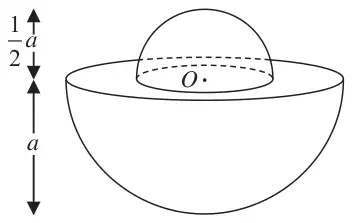
A solid \(S\) is formed by joining a uniform solid hemisphere of radius \(a\) to a uniform solid hemisphere of radius \(\dfrac{1}{2}a\). The plane faces of the hemispheres are joined together so that their centres coincide at \(O\), as shown in Figure 1. The mass per unit volume of the smaller hemisphere is \(k\) times the mass per unit volume of the larger hemisphere.
When \(S\) is placed on a horizontal plane with any point on the curved surface of the larger hemisphere in contact with the plane, \(S\) remains in equilibrium.
| Scheme | Marks |
|---|---|
| \((\pi)\displaystyle\int_0^r y^2x\,\mathrm{d}x = (\pi)\int_0^r \left(r^2 - x^2\right)x\,\mathrm{d}x\) | M1A1 |
| \(= (\pi)\left[\dfrac{1}{2}r^2x^2 - \dfrac{1}{4}x^4\right]_0^r,\ \ = \dfrac{1}{2}\pi r^4 - \dfrac{1}{4}(\pi)r^4 \quad \left(= \dfrac{1}{4}(\pi)r^4\right)\) | dM1,A1 |
| \(\bar{x} = \dfrac{\int_0^r \pi y^2x\,\mathrm{d}x}{\frac{2}{3}\pi r^3} = \dfrac{\frac{1}{4}\pi r^4}{\frac{2}{3}\pi r^3} = \dfrac{3}{8}r\) * | M1A1cso |
| All marks available if \(\pi\) omitted throughout. | |
| (6) |
Notes
M1 Using \((\pi)\displaystyle\int_0^r y^2x\,\mathrm{d}x\) with or without \(\pi\). Must be dimensionally correct with integrand of the form \(\left(a^2 - x^2\right)x\). Limits not needed.
A1 \((\pi)\displaystyle\int_0^r \left(r^2 - x^2\right)x\,\mathrm{d}x\) Correct integral, with or without \(\pi\). Limits not needed.
dM1 Attempt the integration and include correct limits for their equation ie 0,\(r\) or 0,\(a\). Depends on the first M mark.
A1 Correct result, seen explicitly here or at the final stage. Award for \(\dfrac{1}{2}\pi r^4 - \dfrac{1}{4}(\pi)r^4\) or \(\dfrac{1}{4}(\pi)r^4\)
dM1 Using \(\bar{x} = \dfrac{\int_0^r \pi y^2x\,\mathrm{d}x}{\frac{2}{3}\pi r^3}\) \(\pi\) in numerator and denominator or in neither. Depends on 1st M
A1cso Correct given result with no errors seen.
ALT: Start by finding the distance of the c of m from the point of intersection of the axis of symmetry and the surface of the hemisphere:
Equation needed is \(y^2 = 2xr - x^2\) leading to distance = 5/8 \(r\)
Mark as main scheme. Score 5/6 for all correct apart from completion to 3/8 \(r\)
| Scheme | Marks |
|---|---|
| \(\begin{array}{llll}\text{Mass} & \dfrac{2}{3}\pi a^3 & \dfrac{2}{3}\pi\left(\dfrac{1}{2}a\right)^3k & \dfrac{2}{3}\pi a^3\left(1 + \dfrac{1}{8}k\right)\\[1ex] & 1 & \dfrac{1}{8}k & \left(1 + \dfrac{1}{8}k\right)\end{array}\) (NB: No penalty if \(\dfrac{4}{3}\pi r^3\) used instead of \(\dfrac{2}{3}\pi r^3\)) | B1 |
| \(\begin{array}{llll}\text{Dist from } O & \dfrac{3}{8}a & (-)\dfrac{3}{16}a & \bar{x}\end{array}\) | B1 |
| \(\dfrac{3}{8}a - \dfrac{3}{8 \times 16}ak = \left(1 + \dfrac{1}{8}k\right)\bar{x}\) | M1A1ft |
| \(\bar{x} = \dfrac{\left|(48 - 3k)a\right|}{16(8 + k)}\) oe Must have modulus signs | A1 |
| (5) |
Notes
B1 Correct mass ratio - any equivalent
B1 Correct distances from \(O\) or any other point
M1 Attempting a dimensionally consistent moments equation.
A1ft Correct equation, follow through their mass ratio and distances. Signs to be correct here.
A1 Correct final answer. Must have modulus signs \((\because\) sign of \(48 - 3k\) is not known\()\) Numerator can be \(\left|(3k - 48)a\right|\) (No fractions within fractions)
| Scheme | Marks |
|---|---|
| \(\bar{x} = 0, \qquad \therefore k = 16\) ft only if \(k > 0\) | M1,A1ft |
| (2) | |
| (13 marks) |
Notes
M1 Setting their \(\bar{x} = 0\) and solve to \(k = \ldots\) (or imply this by using the separate C of Ms and the respective masses)
A1ft Correct \(k\) follow through their \(\bar{x}\) (Award if earned even if no modulus signs in (b))