
M3 June 2015 Q5
5.
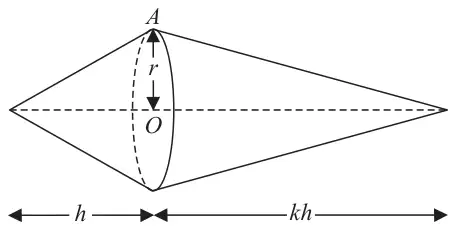
Figure 2 shows a uniform solid spindle which is made by joining together the circular faces of two right circular cones. The common circular face has radius \(r\) and centre \(O\). The smaller cone has height \(h\) and the larger cone has height \(kh\). The point \(A\) lies on the circumference of the common circular face. The spindle is suspended from \(A\) and hangs freely in equilibrium with \(AO\) at an angle of 30\(^\circ\) to the vertical.
Show that \(k = \dfrac{4r}{h\sqrt{3}} + 1\) (6)
| Scheme | Marks |
|---|---|
| Dist of c of m from \(O = r\tan 30 = \dfrac{r}{\sqrt{3}}\) | M1A1 |
| \(\begin{array}{llll}\text{Ratio of masses} & M & kM & (1 + k)M\\ & 1 & k & 1 + k\\ \text{Dist from } O & -\dfrac{1}{4}h & \dfrac{kh}{4} & \dfrac{r}{\sqrt{3}}\end{array}\) | |
| M\((O)\) \(-\dfrac{1}{4}h + \dfrac{k^2h}{4} = (1 + k)\dfrac{r}{\sqrt{3}}\) | M1A1A1ft |
| \(\dfrac{h}{4}\left(k^2 - 1\right) = (k + 1)\dfrac{r}{\sqrt{3}}\) | |
| \(k = \dfrac{4r}{h\sqrt{3}} + 1\) * | A1 |
| (6 marks) |
Notes
M1 Finding the distance of the c of m from \(O\) by using the angle given. Must use tan.
A1 Obtaining \(\dfrac{r}{\sqrt{3}}\) (no approx allowed)
M1 Forming a moments equation using the three known distances; mass ratio only needed – do not penalise use of incorrect formulae
A1 LHS correct
A1ft RHS correct for their distance
A1cao Obtaining the GIVEN answer
Alt 1
| By moments about \(A\) | |
| \(kMg\left(\dfrac{1}{4}kh\cos 30 - r\sin 30\right),\ \ Mg\left(\dfrac{1}{4}h\cos 30 + r\sin 30\right)\) | M1A1,M1A1 |
| \(h\cos 30\left(k^2 - 1\right) = 4r\sin 30(k + 1)\) | A1ft |
| \((k - 1) = \dfrac{4r}{h}\tan 30\) | |
| \(k = \dfrac{4r}{h\sqrt{3}} + 1\) * | A1 |
ALT 1 Taking moments about \(A\)
M1 Attempting the LHS – must have two appropriate terms inc the necessary resolution
A1 Correct LHS
M1 Attempting the RHS – must have two appropriate terms inc the necessary resolution
A1 Correct RHS
A1ft Collecting the terms and cancelling \(M\)g
A1cao Completing to the GIVEN answer
Alt 2
| Find \(\bar{x}\) first | |
| M(0) \(-\dfrac{1}{4}h + \dfrac{k^2h}{4} = (1 + k)\bar{x}\) | M1 A1 |
| \(\bar{x} = \dfrac{h(k - 1)}{4}\) oe | A1 |
| Then suspend: \(\dfrac{\bar{x}}{r} = \tan 30\) | M1 |
| \(\dfrac{h(k - 1)}{4r} = \dfrac{1}{\sqrt{3}}\) \((\text{or }\tan 30)\) | A1ft |
| \(k = \dfrac{4r}{h\sqrt{3}} + 1\) * | A1 |
ALT 2 Find \(\bar{x}\) first
M1 First M mark on e-PEN: Attempting an equation to find \(\bar{x}\) in terms of \(h\) and \(k\) - mass ratio as above
A1 First A mark on e-PEN: Correct equation
A1 Second A mark on e-PEN: Correct expression for \(\bar{x}\) (as shown or equivalent)
M1 Second M mark on e-PEN: Using \(\dfrac{\bar{x}}{r} = \tan 30\) ( LHS either way up)
A1ft Third A mark on e-PEN: Substitute their \(\bar{x}\); LHS must be the correct way up
A1cao Final A mark on e-PEN: Obtaining the GIVEN answer