
M3 January 2007 Q7
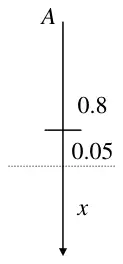
7. A particle \(P\) of mass 0.25 kg is attached to one end of a light elastic string. The string has natural length 0.8 m and modulus of elasticity \(\lambda\) N. The other end of the string is attached to a fixed point \(A\). In its equilibrium position, \(P\) is 0.85 m vertically below \(A\).
The particle is now displaced to a point \(B\), 0.95 m vertically below \(A\), and released from rest.
The particle first comes to instantaneous rest at the point \(C\).
| Scheme | Marks |
|---|---|
| \(T = \dfrac{\lambda}{0.8}(0.05) = 0.25g\) | M1 |
| \(\lambda = \dfrac{(0.8)(0.25g)}{0.05} = 39.2\) (*) | A1 |
| (2) |
| Scheme | Marks |
|---|---|
| \(T = \dfrac{39.2}{0.8}(x + 0.05)\) | M1 |
| \(mg - T = ma\) (3 term equn) | M1 |
| \(0.25g - \dfrac{39.2}{0.8}(x + 0.05) = 0.25\ddot{x}\) (or equivalent) | A1 |
| \(\ddot{x} = -196x\) | A1 |
| SHM with period \(\dfrac{2\pi}{\omega} = \dfrac{2\pi}{14} = \dfrac{\pi}{7}\) s (*) | ↓ M1 A1 cso |
| (6) |
Notes
↓ marks a mark that depends on the M mark above it (an arrow in the scheme).
1st M1 must have extn as \(x + k\) with \(k \neq 0\) (but allow M1 if e.g. \(x + 0.15\)), or must justify later
For last four marks, must be using \(\ddot{x}\) (not \(a\))
| Scheme | Marks |
|---|---|
| \(v = 14\sqrt{\left\{(0.1)^2 - (0.05)^2\right\}}\) | M1 A1ft |
| \(= 1.21(24\ldots) \approx 1.21\) m s\(^{-1}\) (3 s.f.) Accept \(7\sqrt{3}/10\) | A1 |
| (3) |
Notes
Using \(x = 0\) is M0
| Scheme | Marks |
|---|---|
| Time \(T\) under gravity \(= \dfrac{1.21..}{g}\ \ (= 0.1237\,s)\) | B1ft |
| Complete method for time \(T'\) from \(B\) to slack. [\(\uparrow\) e.g. \(\dfrac{\pi}{28} + t\), where \(0.05 = 0.1\sin 14t\) OR \(T'\), where \(-0.05 = 0.1\cos 14T'\) ] | M1 A1 |
| \(T' = 0.1496\)s | A1 |
| Total time \(= T + T' = 0.273\) s | A1 |
| (5) | |
| (16 marks) |
Notes
M1 – must be using distance for when string goes slack. Using \(x = -0.1\) (i.e. assumed end of the oscillation) is M0
(Corrected from the printed mark scheme: \(T' = 0.1496\)s is printed as \(T'' = 0.1496\)s.)