
M3 January 2007 Q5
5.
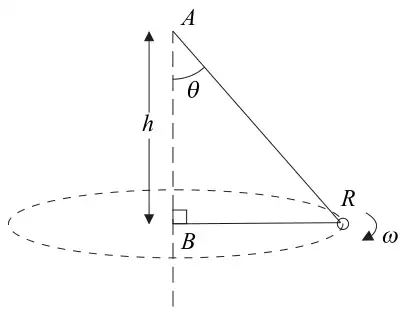
One end of a light inextensible string is attached to a fixed point \(A\). The other end of the string is attached to a fixed point \(B\), vertically below \(A\), where \(AB = h\). A small smooth ring \(R\) of mass \(m\) is threaded on the string. The ring \(R\) moves in a horizontal circle with centre \(B\), as shown in Figure 3. The upper section of the string makes a constant angle \(\theta\) with the downward vertical and \(R\) moves with constant angular speed \(\omega\). The ring is modelled as a particle.
Given that \(\omega = \sqrt{\dfrac{3g}{h}}\),
| Scheme | Marks |
|---|---|
| \(\updownarrow\ \ T\cos\theta = mg\) | B1 |
| \(\leftrightarrow\ \ T + T\sin\theta = mr\omega^2\) (3 terms) | M1 A1 |
| \(r = h\tan\theta\) | B1 |
| \(\dfrac{mg}{\cos\theta}(1 + \sin\theta) = \dfrac{m\omega^2 h\sin\theta}{\cos\theta}\) (eliminate \(r\)) | ↓ M1 |
| \(\omega^2 = \dfrac{g}{h}\left(\dfrac{1 + \sin\theta}{\sin\theta}\right)\) (*) (solve for \(\omega^2\)) | ↓ M1 A1 |
| (7) |
Notes
↓ marks a mark that depends on the M mark above it (an arrow in the scheme).
Allow first B1 M1 A1 if assume different tensions (so next M1 is effectively for eliminating \(r\) and \(T\).
| Scheme | Marks |
|---|---|
| \(\omega^2 = \dfrac{g}{h}\left(\dfrac{1}{\sin\theta} + 1\right) > \dfrac{2g}{h}\ \ (\sin\theta < 1) \Rightarrow \omega > \sqrt{\dfrac{2g}{h}}\) (*) | M1 A1 |
| (2) |
Notes
M1 requires a valid attempt to derive an inequality for \(\omega\).
(Hence putting \(\sin\theta = 1\) immediately into expression of \(\omega^2\) [assuming this is the critical value] is M0.)
| Scheme | Marks |
|---|---|
| \(\dfrac{3g}{h} = \dfrac{g}{h}\left(\dfrac{1 + \sin\theta}{\sin\theta}\right) \Rightarrow \sin\theta = \tfrac{1}{2}\) | M1 A1 |
| \(T\cos\theta = mg \Rightarrow T = \dfrac{2\sqrt{3}}{3}mg\) or \(1.15mg\) (awrt) | ↓ M1 A1 |
| (4) | |
| (13 marks) |
Notes
↓ marks a mark that depends on the M mark above it (an arrow in the scheme).