
M3 January 2006 Q4
4.
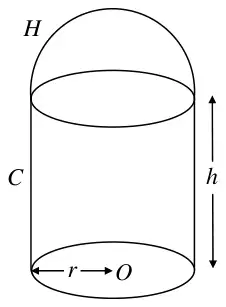
A body consists of a uniform solid circular cylinder \(C\), together with a uniform solid hemisphere \(H\) which is attached to \(C\). The plane face of \(H\) coincides with the upper plane face of \(C\), as shown in Figure 2. The cylinder \(C\) has base radius \(r\), height \(h\) and mass \(3M\). The mass of \(H\) is \(2M\). The point \(O\) is the centre of the base of \(C\).
(a) Show that the distance of the centre of mass of the body from \(O\) is \[\frac{14h + 3r}{20}.\] (5)
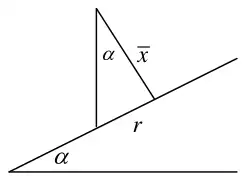
The body is placed with its plane face on a rough plane which is inclined at an angle \(\alpha\) to the horizontal, where \(\tan\alpha = \tfrac{4}{3}\). The plane is sufficiently rough to prevent slipping. Given that the body is on the point of toppling,
(b) find \(h\) in terms of \(r\). (4)
| Scheme | Marks |
|---|---|
| \(5M\bar{x} = 3M \times \dfrac{h}{2} + 2M\left(h + \dfrac{3}{8}r\right)\) | M1 A2(1,0) |
| \(5\bar{x} = \dfrac{3h}{2} + 2h + \dfrac{3}{4}r = \dfrac{7h}{2} + \dfrac{3}{4}r\) | |
| \(\bar{x} = \dfrac{14h + 3r}{20}\) * cso | M1 A1 |
| (5) |
Notes
The scheme links the two M1 marks with an arrow: the second M1 depends on the first.
| Scheme | Marks |
|---|---|
| \(\tan\alpha = \dfrac{20r}{14h + 3r} = \dfrac{4}{3}\) | M1 A1 |
| Leading to \(h = \dfrac{6}{7}r\) | M1 A1 |
| (4) | |
| (9 marks) |