
M3 June 2005 Q5
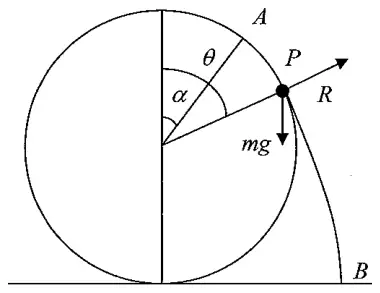
5. A smooth solid sphere, with centre \(O\) and radius \(a\), is fixed to the upper surface of a horizontal table. A particle \(P\) is placed on the surface of the sphere at a point \(A\), where \(OA\) makes an angle \(\alpha\) with the upward vertical, and \(0 < \alpha < \dfrac{\pi}{2}\). The particle is released from rest. When \(OP\) makes an angle \(\theta\) with the upward vertical, and \(P\) is still on the surface of the sphere, the speed of \(P\) is \(v\).
Given that \(\cos\alpha = \tfrac{3}{4}\), find
| Scheme | Marks |
|---|---|
| \(\dfrac{1}{2}mv^2 = mg\left(\underline{a\cos\alpha - a\cos\theta}\right)\) | M1 A1 A1 |
| \(v^2 = 2ga(\cos\alpha - \cos\theta)\) * cso | A1 |
| (4) |
Notes
The underlined A1 is for the underlined expression.
| Scheme | Marks |
|---|---|
| \(mg\cos\theta\ (-R) = \dfrac{mv^2}{a} \quad (R = 0)\) | M1 A1=A1 |
| \(g\cos\theta = 2g\left(\dfrac{3}{4} - \cos\theta\right)\) | M1 |
| \(\cos\theta = \tfrac{1}{2} \Rightarrow \theta = \tfrac{\pi}{3}\) (accept \(60^\circ\)) | A1 |
| (5) |
Notes
The scheme brackets the two M1 marks: the second depends on the first.
| Scheme | Marks |
|---|---|
| From \(A\) to \(B\) \(\dfrac{1}{2}mw^2 = mg\left(\underline{a + a\cos\alpha}\right)\) | M1 A1 A1 |
| \(w^2 = 2ga\left(1 + \dfrac{3}{4}\right) \Rightarrow w = \left(\dfrac{7ga}{2}\right)^{\frac{1}{2}}\) | A1 |
| (4) | |
| (13 marks) |
Alternative: from \(P\) to \(C\)
| \(v_P^2 = 2ga\left(\dfrac{3}{4} - \dfrac{1}{2}\right) = \dfrac{ga}{2}\) | |
| \(\dfrac{1}{2}mw^2 - \dfrac{1}{2}m\left(\dfrac{ga}{2}\right) = mg\left(\underline{a + a\cos\theta}\right)\) | M1 A1 A1 |
| \(w^2 - \dfrac{ga}{2} = 2ga\left(1 + \dfrac{1}{2}\right) \Rightarrow w = \left(\dfrac{7ga}{2}\right)^{\frac{1}{2}}\) | A1 |
(Corrected from the printed mark scheme: the right-hand side is printed as \(2mga\left(1 + \frac{1}{2}\right)\).)
Alternatives using projectile motion from \(P\)
| \(v_P = \left(\dfrac{ga}{2}\right)^{\frac{1}{2}}\), as above | |
| \(\downarrow\) \(u_y = \left(\dfrac{ga}{2}\right)^{\frac{1}{2}}\sin 60^\circ = \left(\dfrac{3ga}{8}\right)^{\frac{1}{2}}\) | |
| \(\downarrow\) \(v_y^2 = u_y^2 + 2g \times \dfrac{3a}{2},\ = \dfrac{27ga}{8}\) | M1, A1 |
| \(\rightarrow\) \(u_x = \left(\dfrac{ga}{2}\right)^{\frac{1}{2}}\cos 60^\circ = \left(\dfrac{ga}{8}\right)^{\frac{1}{2}}\) | A1 |
| \(w^2 = u_x^2 + v_y^2 = \dfrac{ga}{8} + \dfrac{27ga}{8} = \dfrac{7ga}{2} \Rightarrow w = \left(\dfrac{7ga}{2}\right)^{\frac{1}{2}}\) | A1 |
There are also longer projectile methods using time of flight.
| In outline, solving \(\dfrac{3a}{2} = \left(\dfrac{3ga}{8}\right)^{\frac{1}{2}}t + \dfrac{1}{2}gt^2\) gives \(t = \left(\dfrac{3a}{2g}\right)^{\frac{1}{2}}\), | |
| then, using \(v = u + at\) gives \(v_y = \left(\dfrac{3ga}{8}\right)^{\frac{1}{2}} + g\left(\dfrac{3a}{2g}\right)^{\frac{1}{2}} = \left(\dfrac{27ga}{8}\right)^{\frac{1}{2}}\), then as before. | M1 A1 |